
Linbury Theatre, Royal Ballet & Opera, London
October 31, 2025
For their debut UK season, entitled Communion of Light, Joburg Ballet presented five works, most of which came with a very clear South African voice. Led by Dane Hurst, who many will recall as a fine dancer with Rambert in particular, the young company buzzed with athleticism and energy in both the classical and contemporary pieces.
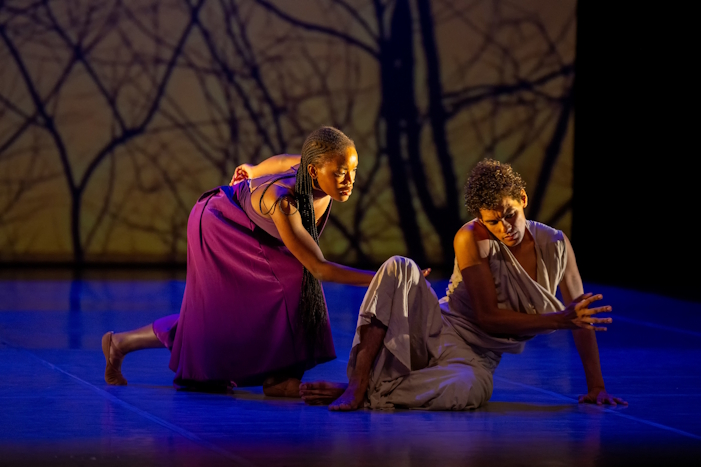
Highlight of the evening, and the work most had been waiting for, came last: Dada Masilo’s Salomé, in which the late South African choreographer adapts Oscar Wilde’s play of desire, power and unbridled passion. It was one of Masilo’s final creation before her sudden and unexpected death in 2024, aged just 39.

in Dada Masilo’s Salomé
Photo Lauge Sorensen
Masilo gives the biblical story a very contemporary outlook as she focuses on the toxic relationships between Salomé and Jokanaan, as Wilde calls John the Baptist, and Salomé and Herod, with the religious aspects of the story kept in the background. It lasts just thirty minutes but everything is here. The characterisations and narrative are as clear as you could wish for. Desire, power and passion are everywhere. The stage is full of sexual tension.
The costumes might be simple but they play their part too. Salomé is in purple, Queen Herodias in yellow, Jokanaan in white. The colour choices tell you all you need to know. Passion, jealousy, innocence. Herod and his acolytes come in formal business suits. The music is eclectic, with contributions from Max Richter, Steve Reich alongside Beethoven’s Seventh Symphony and percussion from Mpho Mothiba.

Photo Lauge Sorensen
As Masilo reflects reflection on lust and the vulnerability of life, it is very dark. The choreography and the performances lend everything a visceral quality, especially that by the superb Latoya Mokoena in the title role. She painted a vivid picture of a woman obsessed, a woman determined to get what she wanted. And on her terms. Her final dance with Jokanaan’s head was quite chilling.
As Jokanaan, Revil Yon was a picture of a man bewildered but, you feel, one who knew what was coming. The detail, the way he flinched at each touch, was remarkable.
Salomé is challenging and deeply unsettling. It is also quite terrific.
Although the quintet of works that was Communion of Light was largely contemporary, it was classical ballet that got things underway. The oldest work on the programme by some distance, Concerto for Charlie was created for the then CAPAB Ballet (now Cape Town City Ballet) in 1979 by Veronica Paeper, as part of a programme sponsored by the cosmetic giant Revlon. ‘Charlie’ refers to the perfume of that name.

Photo Lauge Sorensen
For seven dancers and with no narrative, it is purely a response to Dmitri Shostakovich’s Piano Concerto No.2. It comes with what appears to be a range of influences, including George Balanchine’s neoclassicism and John Cranko’s playfulness, especially in the first and third movements, which are full of ebullient choreography. As the dance fizzes along, the dancers often look at each other in the way a bunch of friends who really get along with each other might.
The meat in the sandwich is the slow second movement pas de deux, however, danced beautifully and with a perfect, contrasting sense of gravity by Monike Cristina and Bruno Miranda. In ballet terms, the music is best known for Kenneth MacMillan’s Concerto, and here especially, it was impossible to shake that ghost off.
Camagwini, Tumelo Lekana’s self-choreographed solo that followed, is about as different as you can get. A fusion of South African traditional movement and ballet, it is apparently “an offering of gratitude to ancestors… a sacred dialogue between the seen and unseen,” none of which I picked up on at the time. With Lekana in long dress and pointe shoes, there also appeared to be a LGBTQ+ connection.

Photo Lauge Sorensen
The meatiest work in the first half was Hurst’s own Resonance, set to South African jazz music from the album South African History !X by leading South African pianist and film score composer, Kyle Shepherd.
Taking inspiration from the energy and spirit of Johannesburg’s historic underground jazz clubs of the apartheid years, the work is at different times, exciting, hard-hitting and thought-provoking. It has a lot to say, so it’s unfortunate that the episodic narrative loses its way and is a little unclear at times.

Photo Lauge Sorensen
Resonance starts by briefly showing the grind of factory work before coming to bright life in one of those jazz clubs where, in amongst the free and very appealing dance, there’s a tender all-male duet, danced here by Revil Yon and David Maluleka.
A sudden darker turn comes as racial tensions make a sudden appearance in the shape of two white foremen who attack the dancers. Later, those same foremen beat up and eventually kill one of men. Very reminiscent of Christopher Bruce’s Swansong and just as powerful, the fight and eventual murder is incredibly well done. It’s very hard hitting and dance theatre at its best. Life goes on, though, and the work ends with a coming together that looks to a hopeful future, and I’m sure a wish for where the country might be heading.

Photo Lauge Sorensen
After the interval, Jorge Pérez Martínez’ Azul (Spanish for ‘blue’) is an essentially ensemble work danced to classical Spanish guitar compositions. With the dancers dressed in blue-green, their flowing movement around the stage is somewhat reminiscent of water. The choreography is easy on the eye but, and while there are constant variations, does start to feel a little repetitive.