

Marylebone Theatre, London
June 22, 2024
It’s not often a new classical ballet ensemble comes along. And even less often that it presents a programme devoted wholly to narrative works. But that’s precisely what Ballet MAR, co-led by Marika Brussel, Ho-Shia Aaron Thao and Richard Bermange gave audiences at the Marylebone Theatre.
The title of the company’s triple bill, Warp & Weft, is a nod to the way yarn is transformed into cloth thanks to the interlacing of vertical warp threads, which form the strong foundation for the material, and horizontal weft threads, the fluid and flexible pattern-making element.
Yarn also implies story, of course, and in Warp & Weft, the three choreographers do their own spot of weaving in three reimagined narratives, updating all in a way designed to resonate with audiences today. It proved an evening of fine dancing and appealing storytelling, with notions of power veined deeply in all three ballets.
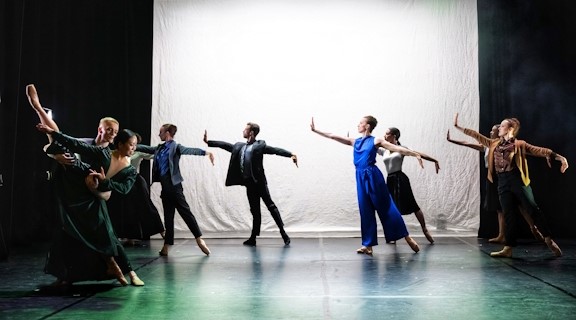
in Ballet MAR’s Iago v Othello by Ho-Shia Aaron Thao
Photo ASH
First up, in Iago v Othello, Thao, co-founder and artistic director of Hudson Ballet Theatre from Westchester County in New York State, transfers Shakespeare’s Othello to the modern day competitive world of corporate law. As a reimagining, it works rather well, the Bard’s themes of manipulation, jealousy and death all too obvious throughout the ballet’s 50 minutes.
In both the original and in Thao’s telling, Iago plots revenge against Othello after being overlooked for promotion, similarly manipulating him into believing his wife, Desdemona, is unfaithful.
Here pictured as a woman, Mayuko Suzuki is superb as Iago. We first see her and Isaac Bowery’s Othello as summer interns on their first day at the law firm. They share a nervousness. But several years on, things have changed. When Othello is promoted and offered the chance to similarly promote a peer, he physically and quite roughly pushes her aside before choosing the debonair Michael Cassio (George Leatherby). Exploding internally, her need for revenge becomes all-consuming, kicking off a chain of events from which no-one emerges unscathed
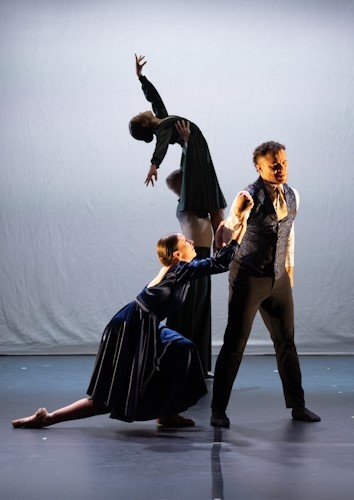
with Mayuko Suzuki (Iago) and Ryan Upton (Envy) behind
in Iago v Othello by Ho-Shia Aaron Thao
Photo ASH
Iago’s feelings are further embodied in the figure of Envy. Danced by the imposing Ryan Upton, he’s the conductor of all that follows and a looming presence almost throughout.
Suzuki’s emotions and intent are shown in her fine dancing and acting. While she shows us very clearly that she’s inevitably attracted to him, there are also moments when she equally realises the depths to which she is descending. But she just can’t stop.
The very classical but also often very dramatic choreography elsewhere speaks loudly of ambition and power too. Other solos and pas de deux evoke well feelings of bitterness and the hunger for power. Ensemble scenes are well constructed and dynamic, but while they do make excellent use of the small space, they do feel crowded. A large stage would benefit the work enormously.
Marc DeSanctis and Ronald Corp’s music, a mix of piano and percussive sounds, works well, especially in the ballet’s darker moments.
Bermange’s 17-minute work, The Maids, a fusion of dance theatre and contemporary ballet, is based on Jean Genet’s deliciously dark 1947 play Les Bonnes, which presents two maids who take turns playing their Mistress when she is out of the house. That roleplay soon turns to murder.
Here, we get three maids rather than two. As in most adaptations of the play, the roles are taken by women (Daisy Bishop, Anna Hirst and Maddie Smith), despite Genet’s original indication that all the female roles must be “played by men and only men.” He added that their make-up must “transform them completely,” believing that such transformation would allow them “any impertinence.”
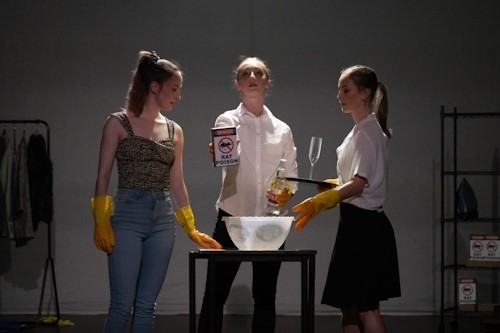
Photo ASH
The action all takes place behind the scenes at a party. The maids are there to cater to the guests every need. But, as they try on the guests’ deposited coats and jackets, and play act the upstairs revellers, they soon start to fantasise about just what they would like to do to them. We’ve all been in a situation where we just wanted to scream and it’s easy to imagine how the trio feel. You can’t help siding with the them.
To a collage of music by Dmitri Shostakovich, Fairuz and Electric Light Orchestra, the threesome externalise and play out their thoughts, occasionally giving the audience knowing looks and glances. Rubber gloves get a lot of use, including a hint that they could be as a means of strangling, but the early lining up of packs of rat poison gives the biggest clue as to where things might be headed. And yet, while amusing, it never quite feels dark enough, never quite tragic enough.
The end is spot on, though. A mixing bowl, rat poison, and bottles of drink. But are they still playing or is this for real? Neatly, Bermange leaves that for us to decide.
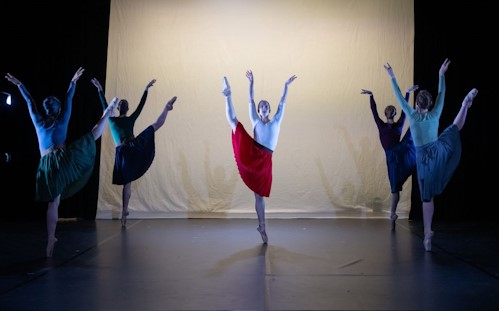
in By a Thread by Marika Brussel
Photo ASH
Finally, Marika Brussel’s own 45-minute By a Thread is inspired by Homer’s The Odyssey. Her focus is not on Odysseus’ wanderings (apart from his meeting Calypso), however, but on his left-behind wife, Penelope, and what she was thinking, feeling and doing through is 20-year absence, seeing her as becoming a strong individual in her own right.
Controlling events, as shown by the way she strategically moves pieces on a downstage chessboard, is Athena, played by Suzuki in an elegant Greek-style long white dress, however. It is she who encourages the strong and confident Michaela Marrable to charge of the world her husband has left behind. It is also Athena who leads Odysseus (Ryan Upton) into battle, and who finally persuades him to return home.

with Mayuko Suzuki (Athena, behind)
in By a Thread by Marika Brussell for Ballet MAR
Photo ASH
Initially quite delicate in their movement, Brussel cleverly shows us how the women gain strength. The scene where Penelope stands up to the suitors who pursue her is particularly powerful, her whole body showing a determination not to succumb. I was less convinced about a subsequent dance with handheld tiny lights that I am guessing is supposed to indicate the women navigating darkness and uncertainty before find the light, their place in the world.
The best pas de deux comes when Odysseus meets Tamara Hinson’s very alluring Calypso. Another smart and strong female (there’s a theme here!), she’s a picture of temptation in a dance of telling looks and excellent partnering.
It just feels a shame that Brussel later passes up the chance for a much longer duet when Odysseus is finally reunited with Penelope. While the dance hints they are now equals, he does very much take the lead, however.
Throughout, American composer Ryan Cockerham’s gorgeous new score emphasises mood and meaning perfectly.
Excellent dancing, good choreography and efficient storytelling. And let’s not forget specially commissioned music. What’s not to like? Warp and Weft was a long evening for a triple-bill, but also one that was rather impressive for a first outing by Ballet MAR. How fine it was to see a new group ticking so many boxes. Let’s hope Marika Brussel and her group return.