
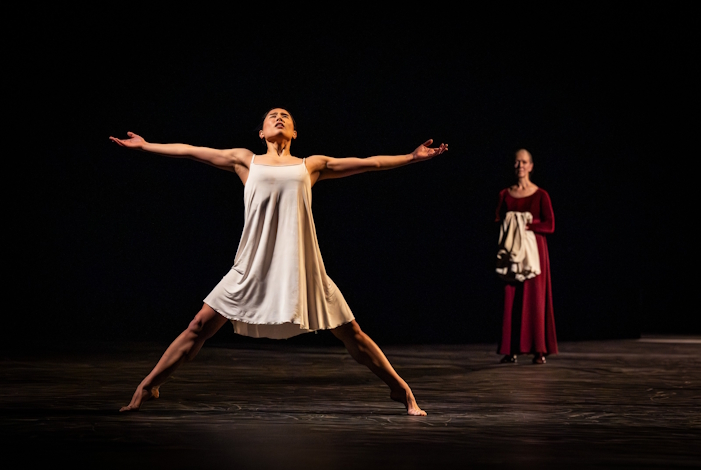
Royal Opera House, Stockholm
February 18, 2026
Mats Ek’s Juliet and Romeo premiered in Stockholm in 2013. Thirteen years later it returns with the same passion. The Royal Swedish Ballet embraced contemporary dance well before most ballet companies. In the 1980s they already had works by Ek and even earlier by his mother Birgit Cullberg.
Ek’s version of the story is a radical rewrite. He switches the order of the protagonists’ names, as Shakespeare does in the last line of his play when he refers to “Juliet and her Romeo.” He moves Juliet to the centre of the drama. She has to face her father’s rage and society’s rejection but the love story at the heart remains as potent as ever.
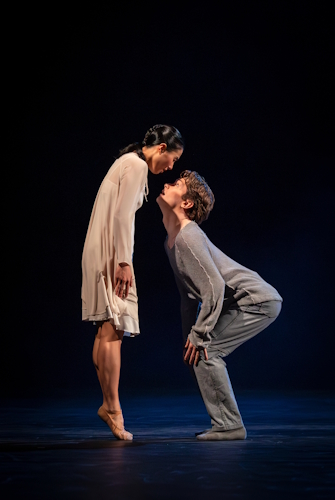
in Mats Ek’s Juliet & Romeo
Photo Kungliga Operan/Håkan Larsson
Kaho Yanagisawa gave Juliet youth and spontaneity that quickly matured into a determined woman wanting to choose her life partner and follow her heart. Julien Keulen, a charming Romeo is her fitting choice and matches her passion. His two mates, an athletic Benvolio, Hiroaki Ishida, and an enigmatic Mercutio, Daniel Norgren-Jensen are substantial well-rounded characters.
In a bold move, Ek dispenses with Prokofiev and uses music by Tchaikovsky in Anders Högstedt’s arrangement, an evocative mix of the well-known and the little known. The ballet opens on a darkened stage, an ominous sky and panels that constantly shift, creating walls and barriers. The fear is palpable; fights break out as Tybalt, Daniel Goldsmith, and his entourage, gliding silently on Segways, take centre stage.
Tchaikovsky’s rarely performed Tempest fantasy overture, filled with harsh and atypical sounds, builds the tension aided by Linus Fellbom’s dramatic lighting and Magdalena Åberg’s sets and costumes which support the drama so well.
Ek’s choreography is austere and muscular with potent images. Paris is introduced without airs and graces. The parents are striking a deal, ensuring the bloodline with the right pedigree. His body is strung out over Juliet’s prostrate form, then lowered in place with no hint of emotion. In their nursery games, Juliet hides in the tent her nurse makes with her long skirt but after the encounter with Paris she turns away when nurse offers her the safe place. Juliet realises her childhood is ended.
The mating game continues in the Capulet’s ballroom. On a stripped bare stage, the men swing their legs in fierce wrapping and unwrapping moves proving their virility. The women respond swinging huge cloaks of jewel-coloured silks as they progress thrusting hips forward. It’s sexually charged and thrilling and Mercutio adds to the mix in black tutu skirt and bare chest, sardonic and mocking, calling out the pretence of honour.
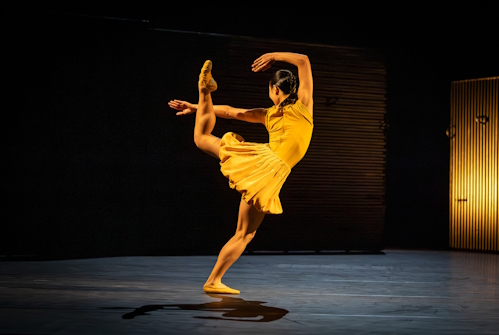
Photo Kungliga Operan/Håkan Larsson
Juliet is presented in a yellow tutu and dances with an honesty denied the rest. She meets Romeo and they freeze, immobile in the flood of emotion and are drawn down under the stage to their own world. The chance to express their love comes in the garden using the romantic theme from Tchaikovsky’s Pathétique. Juliet makes a suitable entrance floating down like in a Chagal painting while Romeo climbs over the wall in traditional fashion. Without reference to family or society they come together in a blissfully candid outburst of feelings; snuzzling up and down each other’s bodies, running and leaping in the air. You can almost hear the laughter.
Their second duet, after the murders of Mercutio and Tybalt is, in contrast, tinged with desperation. They appear in a blaze of light, and the choreographic language has none of the abandon and hope. It closes with Juliet clinging round Romeo’s waist as he runs on the spot but, knowing his escape is vital, he breaks free and is gone.
The second act however opens with humour. Gunilla Hammar inherits the role of the nurse created by the iconic Ana Laguna, and gives an interpretation, different but equally rich in humour and in empathy for her young charge. A seasoned interpreter of Ek’s roles she came to this challenging role with the experience of many years in the Cullberg company. She relishes her foray into the streets to fetch Romeo, riding her Segway with a crash helmet and blue light flashing. It’s high comedy with hung-over mates to the rhythms of Capriccio Italien. In the absence of a Friar, Hammer is both confident and matchmaker, giving Romeo an unexpected kiss before heaving him onto her chariot by the scruff of his neck and taking him to his love.
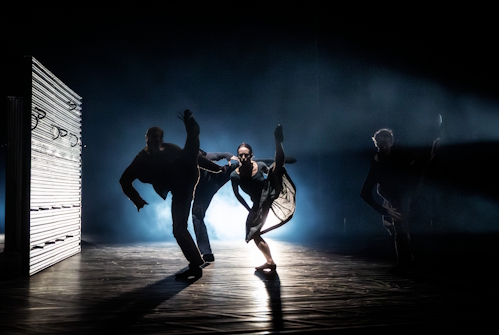
Photo Kungliga Operan/Håkan Larsson
Another interesting casting was Lars Bethke, a dancer, actor, choreographer and director, as the Prince. It’s a role that needs weight, and Bethke delivers. To the crashing chords of Tchaikovsky’s Piano Concerto No.1, he stamps out his frustration with the violent mob, unwilling to give up but going nowhere.
The ending is sombre. There is no swordplay. Mercutio is killed with a blow, Tybalt in a sickening gesture, urinates on the body before he is killed by an enraged Romeo. Juliet’s Mother, Daria Ivanova, mourns Tybalt’s death in the company of the woman, and is burdened with the corpse by her enraged husband.
Juliet gets no sympathy from her father, Dawid Kupinski, and is allowed none from the nurse. It’s a chilling scene and she dies, struck down by a gesture from Kupinski and falls in the half-lowered stage trap. This is where Romeos find her and, in a dream, he dances with her one last time before joining her in death. It is all simply and symbolically played out. They lie in the hollow their legs raised like saplings waiting for the spring and are joined by the ensemble in the closing moment. Ek, following Shakespeare, believes there must be some reconciliation or else all is in vain. It brings a moment of contemplation to a powerful performance of a great work.