The Place, London
January 9, 2026
The evening begins with a voice before it settles into movement. Not as an introduction, but as a presence with movement. Across the opening three works presented at Resolution 26, sound repeatedly insists on being more than accompaniment. It presses into the choreography, shaping timing, attention and pressure on the body. What follows is less a unified approach than a series of negotiations: some held, some strained, some left deliberately unresolved.
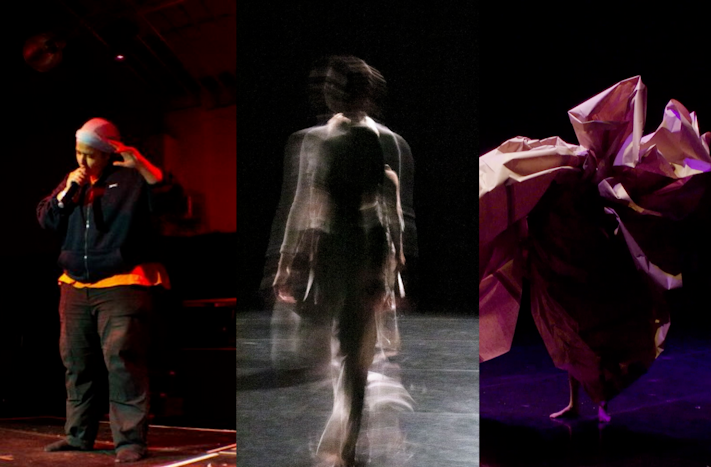
Pet Peeves: an incoherent rambling, created and performed by Paxton Ricketts, is introduced on the programme as a quiet pontification on the little things that nag at us, delivered as a stream of consciousness. Ricketts is a Danish-Canadian artist whose practice includes dance and self-designed sound work, and here he makes the voice itself integral to the choreography.
In this duet between performer and an unruly large sheet of paper, spoken text occupies the space almost continuously. The monologue spills out as a series of persistent thoughts – tardiness, bad jokes, self-critique, even dentistry – that circle without resolution. The sheet of paper becomes the performer’s only partner: folded into shelters, dragged as burden, crumpled into something both protective and oppressive.
The movement contains no recognisable daily gestures, no attempts to act out the words. Instead, the body absorbs the weight of the voice; compressing, hesitating, folding inward. The paper carries pressure as much as it creates. Sound functions less as narrative and more as atmosphere: a mental landscape made audible. The effect is quietly suffocating, softened only by humour that never fully releases the tension. What lingers is not a story, but a sense of being trapped inside thought.
Voices: uncut, a letter to humanity was devised by Sana El-Wakili, an experimental and multidisciplinary artist whose work draws on poetry, dance and lived experience. Performed by her and instrumentalist/singer Lucine, the work is presented as a fusion of movement and spoken word theatre that defies boundaries, blending multi-sensory elements.
A duet, the work combines spoken text with restrained physical action. Language addresses the collective – humanity, peace, harmony – while movement remains restrained, almost cautious. The piece draws on physical theatre and symbolic gesture, occasionally incorporating elements of sign language. Meaning is condensed rather than expanded.
Rather than driving the choreography forward, the spoken text sets conditions. Movement responds, interrupts, or pauses beside it. The body does not carry the weight of the message so much as test its presence. At times, this restraint sharpens focus; at others, it creates distance. The work seems less interested in persuasion than in keeping the question open, allowing language and movement to coexist without fully merging.
Choreographed by Esther Cheong, a dance artist whose practice bridges grounded physicality with exploratory contemporary forms, the title of KiaSu is drawn from the Hokkien phrase meaning ‘fear of losing.’ Performed by Amanda Pang, Vidushi D’Souza, Nicole Maltezaki and Alejandro Villalobos, it’s a bold exploration of conformity and insecurity.
Spoken language enters briefly, functioning rhythmically rather than semantically. From the outset, slanted lighting and spatial design carve the stage into lines of tension. The four dancers move through conflict, alignment and interruption with clear physical intent.
Rhythm is shared. Movement, sound and timing lock into a common pulse, generating urgency without excess. Physical interactions – blocking, pulling, queuing – are sharply articulated, exposing social pressure through the body rather than explanation. The choreography is precise and engaging, though the specificity of its concept may not be immediately legible without prior context. What remains unmistakable is the sensation of pressure: of needing to keep up, to stay in line, to not fall behind.
This opening evening of Resolution ’26 reflected a broader tendency in contemporary choreography, where sound increasingly used in body creative. Works have moments when movement and sound briefly share responsibility, and others when they separate, each following its own logic. When that split becomes visible, sound risks explaining while the body continues elsewhere. When it holds, even momentarily, attention sharpens, not because meaning is clarified, but because uncertainty is sustained. These approaches demand a high level of embodied practice. Choreographers need to be able to direct sound and movement together. Without, works risk feeling abrupt or uneven.
Resolution 26 continues at The Place to February 24, 2026.