
Cadogan Hall, London
February 4, 2026
Ballet Nights celebrated its tenth London programme, Decadance, with an excellent evening of dance at Cadogan Hall, ahead of its first UK tour. There was much to like and something for everyone in an evening of classical and contemporary dance that brought together well-known names and Ballet Nights favourites with emerging dancers and choreographers, and that featured the UK debut of Mexico’s Ballet de Monterrey.
As has become the Ballet Nights tradition, the programme opened with house concert pianist Victor Erik Emanuel, this time playing Claude Debussy’s best-loved piano piece Clair de Lune, the third movement from his Suite Bergamasque. Debussy once said something along the lines of ‘Music is the space between the notes,’ and there’s certainly a lot of space in the captivating, spare and instantly recognisable first part.
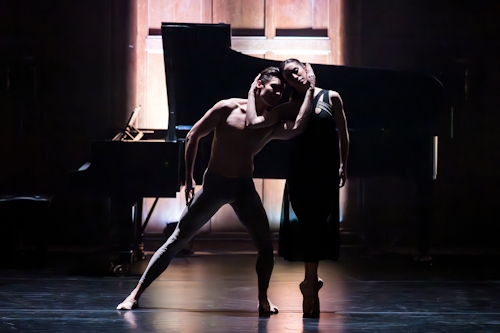
Photo Deborah Jaffe
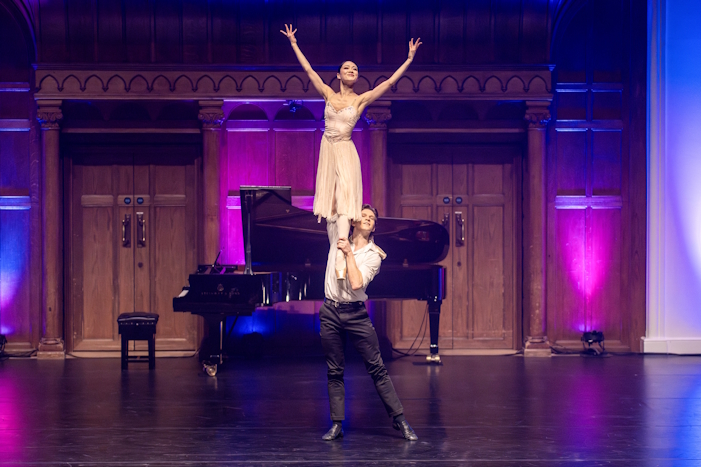
The dance got off to a perfect start with The Royal Ballet husband and wife pairing of Sae Maeda and Harris Bell in Vasily Vainonen’s Moszkowski Waltz. It may be charming and light but it also comes with a lot of tricky partnering, all perfectly executed.
Out Of Breath by Northern Ballet dancer and choreographer George Liang is a finely-crafted neoclassical short about the uncertainty of two people seeking connection. To music by Ólafur Arnalds, a shadowy, rather cinematic and tentative opening, it builds very nicely to a point where dancers Alessandra Bramante and Joseph Taylor find connection and warmth. It was just a shame some of the lighting changes were somewhat jarring and sudden, although that in the central section, which gave the scene an almost black-and-white movie quality was super.
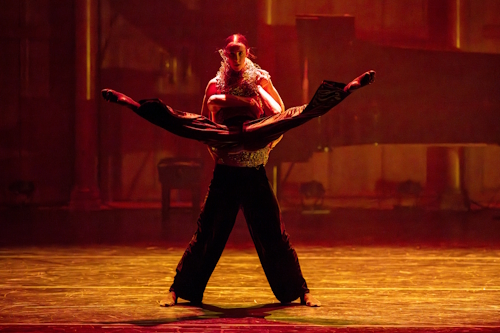
Photo Deborah Jaffe
PCK Dance, James Pett and Travis Clausen-Knight, have been part of Ballet Nights from the beginning. Receiving its world premiere, AE, danced by Clausen-Knight and Isabelle Evans sets out to ask how you prove you are human. It’s a fine, complex piece of choreography to music by Sean Pett, James’ brother, but the connection to its inspiration and theme was lost on me.
Without doubt, the busiest piece of the evening was the Times Square Ballet from On The Town, choreographed by Ashley Page, enthusiastically performed by dancers from Central School of Ballet. While very much an ensemble piece, there is enough space in it for its many characters to show through.
in Dov’è la Luna by Jean-Christophe Maillot
Photo Deborah Jaffe
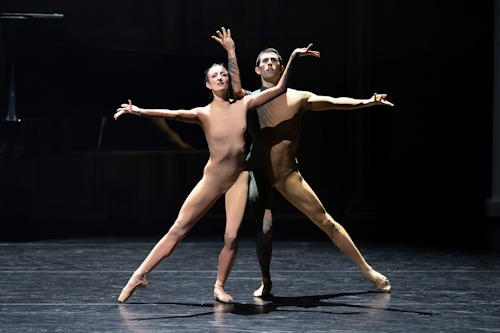
Neatly tying in with the Clair de Lune (Moonlight) opener, the first half was brought to a beautiful close by Lou Beyne and Jaat Benoot of Les Ballets de Monte-Carlo in an intimate and poetic duet from Dov’è la Luna (Where is the Moon) created in 1994 by Les Ballets de Monte Carlo artistic director, Jean-Christophe Maillot. Part of what is described as a ‘solemn mass for seven dancers’ that explores life, death and rebirth, the neoclassical choreography is simple and stark in presentation, the couple moved sleekly through light and shadow. Jérôme Kaplan’s body suit costumes, nude coloured at the front but with blue detailed on the back and one arm, are as elegant as the dance.
If anyone needed waking up after the interval, Viola player Dominic Stokes certainly did so with the all to brief fourth movement of Paul Hindemith’s Viola Sonata, Op.25. Furious from the off, it may have been written in 1922 but sounds unbelievably of today.
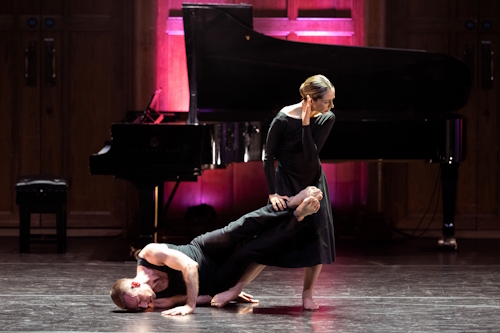
in Robert Cohan’s Lacrymosa
Photo Deborah Jaffe
From Hindemith to Robert Cohan, one of the founding fathers of contemporary dance in the UK. His Lacrymosa considers what happens when someone you love returns after time away, but has changed. Yorke Dance Project dancers Edd Mitton and especially Amy Thake projected much sense of uncertainty from her at the beginning evidenced by her moving towards him then stepping away again, unsure. Even when they come together there appears to be uncertainty in her mind, almost as if she’s trying to come to terms with what, who, he now is. Very stylised and of its time, it was beautifully performed.
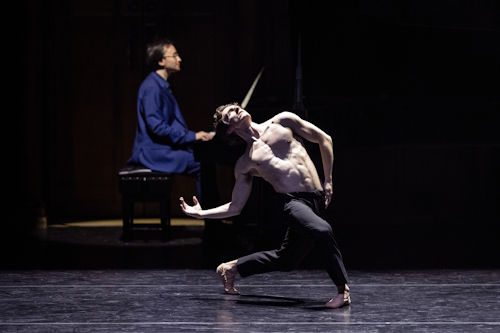
Phoro Deborah Jaffe
Royal Ballet soloist Joshua Junker’s 324a has been danced by several others but here the choreographer took on the work himself. 324a was his address during lockdown and the work is certainly full of the sense of confinement, the feelings and emotions of the time.
The Rambert School’s PLATFORM programme not only gives students the opportunity to create work, but also provides connections for music and costume. Choreographed and performed by Chrysanthi Nikolaou and Django Bates-Blower, Atlas may be abstract in a narrative sense but it’s very at one with the music by Ori Lichtik, Sharon Eyal’s usual go-to composer. It is just a shame it rather fades away musically and choreographically rather than coming to a definitive end, though.
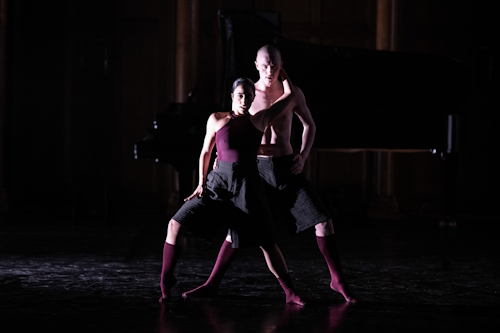
in their Atlas
Photo Deborah Jaffe
The definition of man was once his ability to use tools, observes Royal Ballet principal dancer Matthew Ball. He certainly does that in his solo, The Measure of Things, in which he dances with a 2-metre-long metal pole. It’s used in myriad ways. It’s a plaything. It’s twirled like a baton. It’s a support. It’s used to slide down. And much more, all the time prompting and allowing new ideas and movement. At times too, it’s not so much a prop as a friend. Unusual and very good. And all to Beethoven’s Piano Sonata No.31 played live by Emanuel.
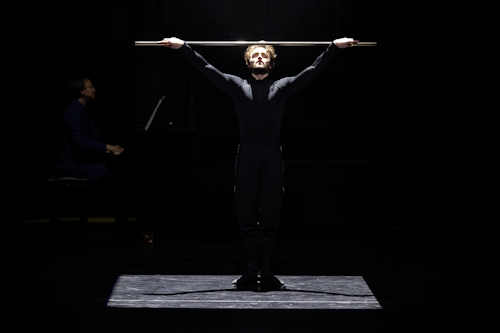
Photo Deborah Jaffe
The evening closed with a gala regular, the Diana and Acteon Pas de deux danced by Laura Rodriguez and Gael Ventura of Ballet de Monterrey. Rodriguez is well-known to British audiences through her performances with Acosta Danza and with Carlos Acosta himself in On Before, but it was good to see her in out and out classical choreography. She shone beautifully, with her long balances and fine series of fouettés the highlights. Ventura looks a super partner, although his best moments came alone in his variation. I’m not sure about his gold-coloured skirt, though.
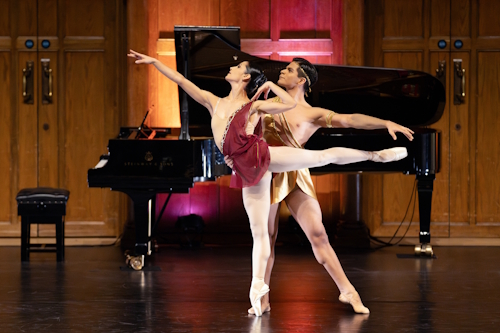
Photo Deborah Jaffe
As always with Ballet Nights, the evening was nicely compèred with the occasional dose of easy-going humour by artistic director and founder, Jamiel Devernay-Laurence.
It is remarkable to see how far Ballet Nights has come in just two years. Devernay-Laurence’s idea grew quickly, and is still growing with performances overseas and a first UK tour coming in March. The idea itself was a risk. The move from Lanterns to the larger Cadogan Hall was a risk. But, as he says, every night is still “built around the belief that dance should feel close, human, and worth showing up for. The story continues, and the adventure is only just beginning.”
Ballet Nights visits the Richmond Theatre; Theatre Royal, Brighton; and Opera House, Manchester during March. Visit www.balletnights.com for dates and booking links.
Ballet Nights 011: Convergence is at Cadogan Hall, London on April 29, 2026.