
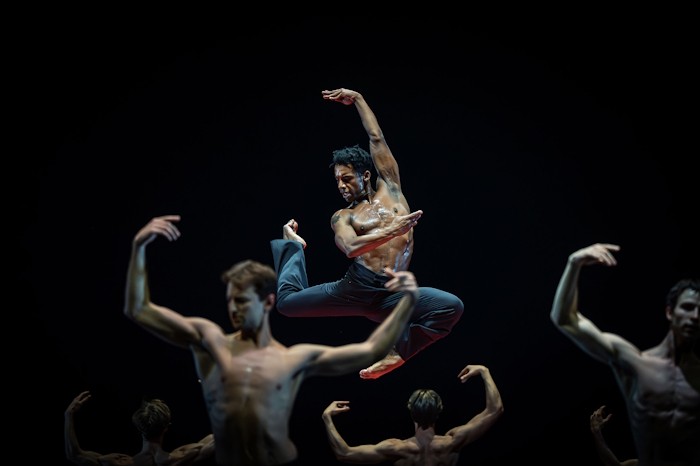
If there is one work that made choreographer Maurice Béjart’s name, it is his celebrated Bolero, premiered in 1961. Ahead of its featuring on the Bayerishes Staatsballett’s ‘Waves and Circles’ triple bill, Jeannette Andersen talks to Piotr Nardelli about staging the once seen, never forgotten work, and why he thinks the ballet is still such a success.
Having graduated from the National Ballet School in Warsaw, former Béjart dancer, Piotr Nardelli performed with Roland Petit’s then newly founded Ballet Nationale de Marseille, and spent a year with the Swedish Royal Ballet in Stockholm, before joining the Ballet du XXe Siècle in 1973.
He says, “The day I started dancing with Maurice Béjart, I knew it was the last company I would dance in. We were 64 people and almost everybody came from another country, so we all felt a little lost. But we had the solidarity between us. At that time there were no stars or soloists except for Susan Farrell, who briefly joined the company before returning to New York City Ballet. One day you danced in the last line of the corps de ballet, the next in a principal role.
“One of my first performances was on tour in Iran, for some kind of celebration. After that we went to Africa, Tunisia, Morocco, etc. Maurice Béjart was very famous, and the company was very successful everywhere. He was also one of the first ones to take dance out of the small theatre. We danced in the Arena in Verona for 12,000 people and in other venues for 4,000 to 5,000 people.”
Nardelli performed with the company for seven years. When he decided to stop dancing, Béjart asked him to teach at his school, Mudra. He also taught the company.

in a stage rehearsal of Maurice Béjart’s Bolero
Photo Nicolas MacKay
Amongst his performances were many as one of the four soloists in Bolero. He also staged it in 1975 with Maya Plisetskaya and the Bolshoi Ballet. Nardelli says, “Maya Plisetskaya was 50, and she wanted to dance Bolero for her birthday jubilee. At first, the idea was to stage it with the Bolshoi in Moscow, but the Ministry of Culture found the ballet too sexual. So, when the company went on tour to Australia, I joined them and taught the company the ballet, and they performed it there.” As far as he knows, they never did dance it in Russia.
Nardelli did not speak Russian and Plisetskaya spoke nothing but, but somehow, they made it work. He says, “Everybody was thinking, she is a big star and speaks many languages. But she did not. The company organised an interpreter, but it made her panic. So, they asked me to coach her: I had learned some Russian at school in Poland and spoke Polish with a Russian accent, and we started to understand each other. She was a divine ballerina, one of the best in the world, but she had difficulty learning the steps. Because in Russia they were only taught classical ballet. But she got it and the result was very, very good.”
The dancer Ida Rubinstein commissioned the music to Bolero from Maurice Ravel in 1928 and danced it herself the same year in a choreography by Bronislava Nijinska on a round table with dancers around her, very similar to Béjart’s version.
Nardelli explains, “Ravel did not really want to compose the music for her, but eventually he wrote, I think, 64 counts, which he then developed. When he saw her dance to it on a large, round table, he was shocked. He did not like it at all and left before the end.”

Photo Nicolas MacKay
Nardelli does not know if Béjart saw Rubinstein, but before he went to Australia, he asked him how he created his ballet. “He explained that one day he was sitting in a Greek tavern, when a woman started to dance slowly at the centre of the room. Man after man started to dance with her. He said, this was his inspiration. He also felt that the rhythm in Bolero reminded him of sirtaki, a traditional Greek dance.”
At the premiere of Bolero in 1961, Duska Sifnios danced the woman on the table. But in 1979 Béjart allowed the Argentinian dancer, Jorge Donn, a principal with the Ballet du XXe Siècle, to perform the part.
Nardelli says, “The original version was with a woman, and for many years, only women danced the main role, even though many male dancers asked for Bejart’s permission to dance it. I do not know exactly what made him change his mind. But he was a cineaste and the French film-maker Claude Lelouche had made the movie Les Uns et les Autre, based on Rudolf Nureyev, in which Donn was a dancer. The story finishes in Paris at the Tour Eiffel, where Donn is dancing Bolero. After that men were allowed to perform the part.”
The choreography is the same whether the part is danced by a man or a woman, also for the forty men dancing around the raised table. But it does make a difference, says Nardelli. “When a woman dances on the table, the men around her are looking at her and loving her. When it is a man, it is more like a competition.”
Nardelli is staging the ballet with both a woman and a man in the main part, and he has enjoyed working with the Bayerisches Staatsballett. He says, “It is a very, very nice and good company The dancers are open, they ask and they react. The company holds a lot of talent. That is fantastic.”
Next year, Bolero will be 65 years old. But every time it is danced it is still a huge success. Nardelli has some thoughts as to why people continue to like it. “You have this choreography from 1961, and it is looking a little bit dusty, but it is still up there. Maybe it is because of the symbiosis between music, movement, understanding the crescendo and the progressive movement, that makes it an enormous success with standing ovations every time it is danced. The music is fantastic. The piece is interesting because we have a table with forty men around it. And there is that progression towards crescendo. It starts slowly and then becomes more and more. You can feel passion and real energy growing.”
The Bayerisches Staatsballett’s Waves and Circles triple bill opens on December 21 at the Opera House, Munich.
Alongside Béjart’s Bolero, in which Osiel Gouneo will dance the main role on first night, followed by Elisabeth Tonev on December 25, with other casts thereafter, the company will also perform William Forsythe’s Blake Works 1 (2016) and Emma Portner’s new piece, Megahertz.