
The Place, London
February 21, 2026
A loud night, twice compelled to watch, finally seeing people only at the end
It was a loud night. Not in decibels, but in the way each of the three short works occupied the act of looking. The pieces arrived like three different interrogations, pushing the audience into three different viewing postures. But only in the final work did I feel I was watching people again, rather than symbols, issues, or a mechanism of the gaze.
Anxious typing, bodies glued together
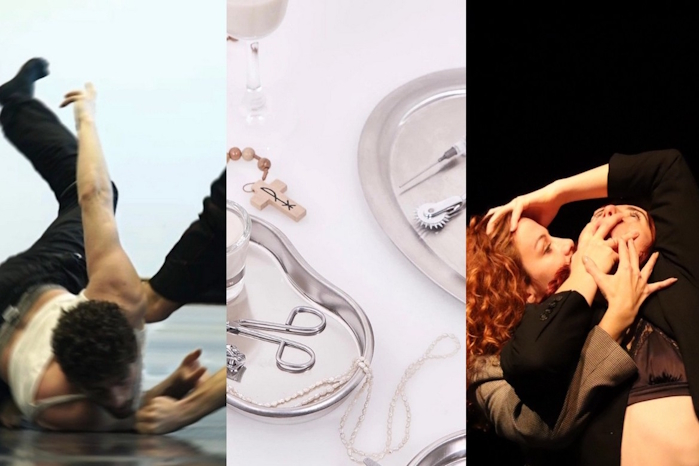
Leoni da Tastiera (Keyboard Lions) by Antonello Sangirardi opens with two male dancers, bare-chested in black briefs, entering in odd, angled shapes, like unfamiliar creatures released into a room and left to pace. They begin with a slow-motion fight, strange but compelling, as if testing each other’s weight, leverage, and recoil.
They then stretch, walk to the two small areas marked out with orange rope at either side and pull on clothes from chairs. Once dressed, another rhythm takes over. Seated, they grip their phones and message each other on a social media platform. The typing accelerates. Anxiety stacks into tempo. A projection behind them displays their messages, but from my seat the image is blurred and the text refreshes too quickly to read closely. The content warnings in the foyer list political and religious references; the projection seems to carry that informational layer, yet it remains out of reach at this distance.
While waiting for replies, each dancer drops into a solo, like private static in the body. The taller performer has a fluent floor vocabulary, incorporating seamless acrobatics and inverted phrases. The other has striking flexibility and control, able to hold tension and release with unnerving precision. Then they ‘notice’ each other and start to argue. The only lines that land clearly in the theatre are fragments such as “You are gay” and “White is always right.”
A handclasp changes everything. From that instant, they cannot separate. Fear, shrieking, a kind of pleading toward the audience. Fighting returns, then knotty entanglement, lifting, and a sustained stretch of contact work that binds two bodies into a single problem. Terror sits alongside a strange, reluctant sensuality. When ‘Stranger in the Night’ suddenly drops in, the stage feels spiked with an ill-timed joke, and the audience is forced into a decision: laugh, or grow even more uneasy.
Leoni da Tastiera piece has an intention, yet its informational layer behaves like a fast-scrolling window: present, flashing, hard to hold. As dance, though, it is undeniable. Two highly capable performers. A peculiar, effective physical language that stands on its own terms.
Beauty overwhelms the gaze, sexiness collapses
Created and performed by Host Bodies, Anatomy of a Siren goes to the opposite extreme. Two young women, Ronan Cardoza and Chiara Martina Halter, appear with an almost unreal radiance. Their beauty is not in dispute.
The opening image holds the room. One dancer wears nude shapewear, a rope tied from her right ankle to her glossy red curls, lying prone at centre stage. The other, with hair that is genuinely white, stands by one of two baby cradles. Her breasts are bound with rope, shibari-style. She wears white on top, and below, tiny lace-trim briefs layered with a black, furry thong. She barely needs to move to pull focus.
Cardoza and Halter’s flexibility is extreme, bending into shapes that verge on the non-human. Movement stays largely slow, curves stretched and displayed. Sexual suggestion, and sometimes something closer to explicitness, repeats as structure: legs opened and held open; vibration against the floor; kneeling with hips lifted toward the audience. The black furry thong drags the gaze to the space between the thighs. Imagination does the rest.
The strange thing is that while there is such beauty, such sexual coding, still I do not register it as sexy. Watching starts to feel compulsory. The longer it goes on, the more glaring the fact of watching becomes. Halfway through, I start checking my watch. One thought keeps looping: surely this is enough. If those beautiful legs extend into the air again, and my eyes get pulled back to that patch of black, I feel I might snap.
Props mix sex with reproduction. A fake pregnant belly appears. Later, a three-breasted object. At that moment the work’s volume spikes, louder than the first piece ever gets. It places hard-to-face sexual display alongside one of the most consequential functions of the female body, then forces the audience to sit with the collision. The room looks stunned. Someone near me says, plainly, that they do not like it. I acknowledge the impact. I acknowledge that my viewing power is flipped. I refuse to deliver a moral verdict. The work does not strike me as simply ‘bad.’ It is loud. It is messy. I cannot, and will not, define it into safety. On the matter of reversing the gaze, you win. What you want me to take away, I cannot yet name.
The ending produces a small collective embarrassment. Blackout. Music stops. Applause breaks out too early. Lights return, then drop again, then return again. The audience hesitates, chastened, until the actual bows give permission to clap. Even the timing of applause feels briefly taken out of our hands.
Clothes return, people return
MORE by AmyFoskettDance arrives like an exhaled breath. Dancers Ellie McDonald, Olivia Wallis-Jackson and Amy Foskett are wearing actual clothes. I almost think, thank goodness. After two works that shout, MORE speaks in a more traditional dance register. There is no theatrical machinery, no sexual proposition, no gender performance, no framework that forces me into a particular position as viewer. It is a flowing relationship piece: three women supporting, constraining, contesting one another.
The music sits underneath, steady and unobtrusive. Still, choreography listens closely. You can see phrases land on accents, soften into slides, and ride the line of a glissando. The movement does not chase the score. It meets it.
At the start, the performers help each other climb towards the upstage wall, as if searching for an exit. Then the relationships begin to shift. There is three-way support, and three-way shoving and tugging. The work runs through set, highly practised contact work in clear groupings, duets built from support and lifting, cleanly constructed and confidently delivered. Several passages place one dancer at the side watching while the other two move. That onlooker reads, sharply, like the third member of a small friendship circle: temporarily edged out, or quietly preparing to step in and rewrite the dynamic.
Throughout MORE, closeness has a price. The dancers move towards something together, borrowing each other’s force to advance, then, as they reach it, hands begin to pull and resist. Nobody wants to yield ground. Support carries care, and also control. Tugging carries rivalry, and also the refusal to let go.
In the final moments they return to the upstage wall. Nobody escapes. Nobody escapes these things. The dance vocabulary is classic contemporary technique, familiar and reliable: release into the floor, fluent floorwork, repeated counterbalance and weight sharing. It holds without theatrical explanation and without symbolic amplification. Where the earlier works force the audience into a state of compelled looking, MORE brings me back to a more ordinary kind of attention: music, dancing, and the exchange of weight and trust between people. At that point I realise how much I need it.
Looking back, the evening offers three different ways of using bodies, and three different ways of using an audience. The first lets anxiety glue bodies together. The second turns beauty into a trap. The third switches off the signs and returns us to people.