
Muffathalle, Munich
January 28, 2026
Gauthier Dance enthralled the Munich audience at the end of January with Akram Khan’s Turning of Bones, which he created for the company in June 2025. It is a tale of love and violence, of belonging to or being expelled, of life and death, all taking place in the liminal space between reality, dream, memory and something more difficult to put into words, perhaps ‘La Condition humaine.’
The inspiration for the piece was the Madagascan recurring ritual, Famadihana, or the ‘turning of the bones’, during which people commemorate their dead by exhuming their bones, dressing them in new silk and then dance with them. Khan turns his own bones, metaphorically speaking, taking excerpts from four older pieces, reworking and mixing them, and dressed them in new garb. The evocative soundscape, spanning from the howling of the wind, to the sound of hammering on metal, to the song Hallelujah and more in between, was created by Khan’s longtime collaborator Aditya Prakash. The mix also includes other Prakash, Jocelyn Pool and Ben Frost compositions, originally used for other works.

Photo Jeanette Bak
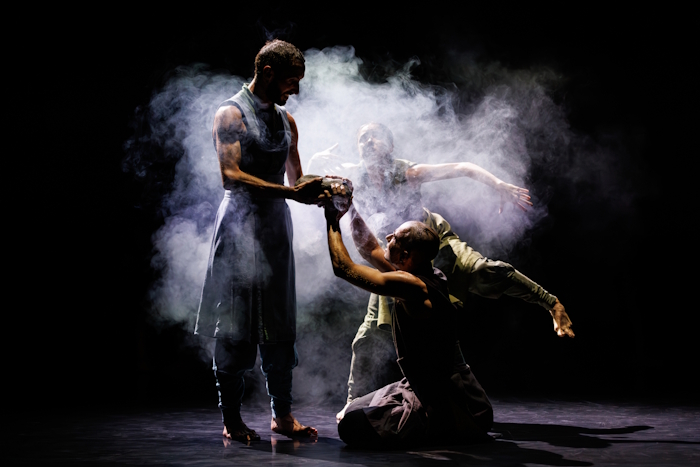
A couple, superbly danced by Tuti Cedaño and Stefano Gallelli find themselves in a half-circle of thirteen dancers sitting in three rows, immobile like statues. The sounds of a gong, a hissing or perhaps the wind pressing through rock crevices creates a feeling of being in a sacred place. The woman touches a man sitting with a stone at his side. He drops forward, like an ancient skeleton crumpling when exposed to air.
Gradually, the seated figures come to life, while the couple engage in what looks like a sexual act. He lies on the floor; she stands above him. Their duet is partly loving and affectionate, although partly it also looks like an ancient ritual of power and submission. They rise and the dancers from the half-circle enclose the man. With their hands they press him down, and it looks like he disappears in their midst. In a frenzy of movements, the group then tries to catch the stone, held by the man, danced with fervor by Giovanni Visone. In the end Cedaño takes it.

in Akram Khan’s Turning of Bones
Photo Jeanette Bak
The group is clad in light blue or green wrinkled leggings and knee-length dervish-like dresses by Gudrun Schrezmeier. Perhaps an indication that they belong to an ancient clan.
Like performing a ritual, a woman, instigated by Visone, appears like a priestess and smears black paint on Cedaño ‘s face. Making her look like the rest of the group, it also marks her as the ‘chosen one.’ But as later becomes apparent, not as the one to be sacrificed, but the one to commit the sacrifice.

in Akram Khan’s Turning of Bones
Photo Jeanette Bak
The ensuing dancing becomes increasingly wild and violent. The group make as if stabbing themselves in their stomachs, perform slow dervish-like turns and big sweeping arm movements like wind brushing through air. Men, first one, then more, push a woman to the floor, take a strangling grip on her throat, then let go, only to put a crushing foot on her neck. She tries to rise, but drops dead. The men then drag their dead bodies across the floor.
The lover is clad in the same costume, but in black. The group, alive again, paint the top of his bald head with what looks like two eyes and a mouth, and force him to move bend over, so this becomes his new face. It turns him into a cartoon-like figure, a funny-looking, weird, shaking creature; the one to be sacrificed.
The grueling rituals continue. Shots are fired. They all drop then carry the man over their heads like the dead Christ. Three men stand upstage, while whispering voices say, “Abraham only Isaac.“ Finally, they push the lover around with increasing violence until finally the chosen one strangles him.
All motion stops. The leading man, Visone, offers her his hand. She refuses to take it and walks away from him and the group, for which she sacrificed her love one. She finds him behind the translucent backcloth, now a distorted figure, whose hand she briefly touches, the fabric between them, before he disappears.
Turning of Bones begins with the words “I must die. You must live.” Later, the sentence is repeated with “to tell our story” added. And this is what the woman does. She tells her story of love, woe, sacrifice and despair. As the work unfolded, I did wonder why she had to sacrifice her lover, and what motivated her to do it. A myriad of explanations came into my mind. She is under peer pressure, she sacrifices him to save her people, but her actions are open to many other interpretations. And the answers do not really matter, because the dancers sweep the viewer into a wonderous world, full of rituals and strong emotions, easy to identify with, and everything expressed through great dancing.
Gauthier Dance and Akram Khan’s Turning of Bones will open the Belgrade Dance Festival on March 13, 2026