
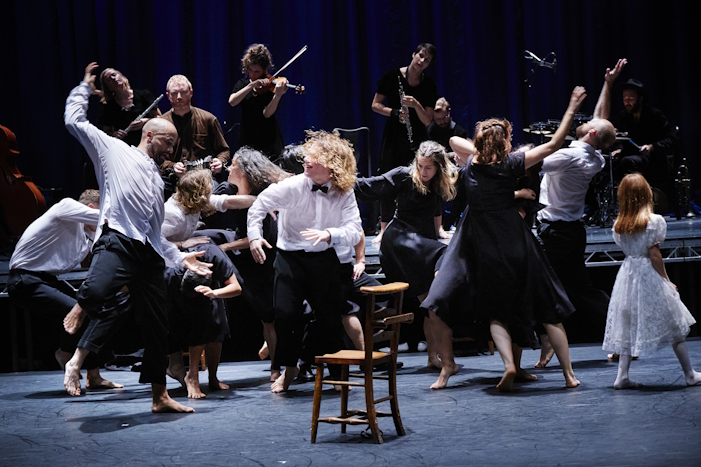
Birmingham Hippodrome
February 6, 2026
Created in 2019, MÁM was the first show created entirely by Teaċ Daṁsa and artistic director Michael Keegan-Dolan in the company’s West Kerry home. It’s a piece that is firmly rooted in the landscape and culture of the area. It’s a gathering. At times, it has the joy of a ceilidh, but it also has a dark, mysterious edge, and is often quite disconcerting.
The Gaelic word of the title is rather fluid with multiple meanings including a mountain pass, a handful, an obligation and a yoke. Similarly, Keegan-Dolan’s MÁM is open to numerous interpretations. Every now and again there’s a feeling that the dancers are drawing on bits of memory. There’s a bit of an air of nostalgic melancholy.
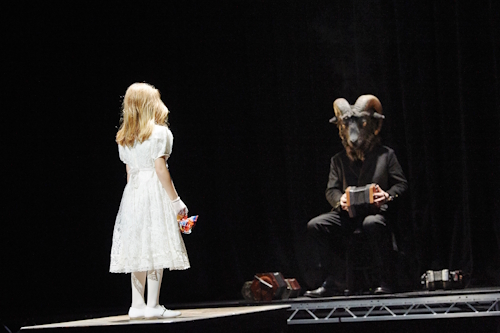
Photo Ros Kavanagh
The opening is starkly monochrome and speaks of pagan ritual, although that sense soon passes. A child in a white dress, Delilah Nielson, white lays on a table before standing to face a seated figure in a horned ram’s mask, soon removed to reveal the well-known West Kerry virtuoso concertina player Cormac Begley.
A curtain pulls back to more seated, masked figures in formal black. Hands and feet create percussion before Begley’s accordion strikes up, Irish rhythms flood the theatre, and MÁM begins its strange and somewhat unsettling journey.
For much of the work’s eighty minutes, Nielson is an observer, watching the adults around her. Her white dress helps project her air of innocence, although she increasingly joins in with the goings-on of the grown-ups, slowly being allowed into their world.
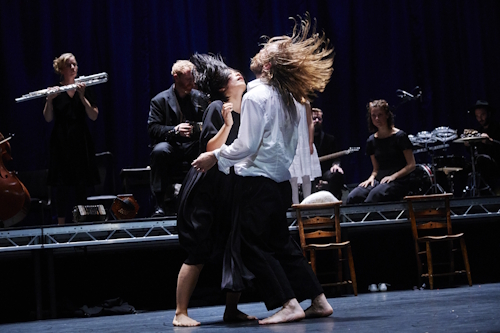
Photo Ros Kavanagh
Pina Bausch once said that she was not so much interested in how dancers move as what moves them. And what seems to move the dancers in MÁM is the music. Time and again they do not so much dance to the fabulous live music of Begley and European classical contemporary collective s t a r g a z e but are driven by it. The fabulous sounds take over body and mind.
MÁM has echoes of Bausch in the way the work unfolds. Like Bausch in Kontakthof (soon to be restaged at Sadler’s Wells in a fusion of past and present that includes some original dancers and archive film), Keegan-Dolan paints pictures of a gathering in a community hall. The performers line up seated on chairs, they eat crisps and drink. One smokes. Those chairs are also used in the choreography, sometimes aggressively. At one point the dancers split into two lines and face off against each other, screaming and howling as they do so. But while scenes come and go, they always do so smoothly. Not a single one jars.
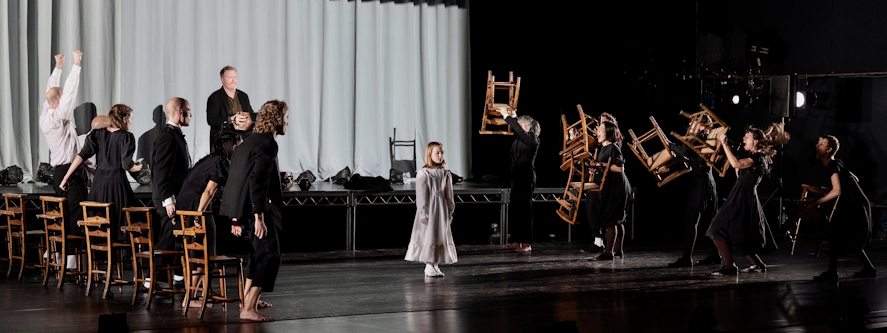
Photo David Gray
But while there are elements of Bausch, structurally and in the way moments that are very ordinary and rooted in the everyday are incorporated, MÁM has an edginess and sense of mystery that her work rarely has. It is very unique. A piece rooted in Ireland for sure. And a piece that paints some fabulous pictures. Just maybe not those one expects to see.
The choreography is staggeringly wide-ranging in style. Traditional steps run up against contemporary forms. The fabulous dancers frequently spin and turn at length. One drunken male solo is especially impressive. There are moments of tenderness, of kindness, of frustration and of violence. But scenes are invariably recognisable, always, always anchored in real life, real people and the interactions that happen at big social gatherings.
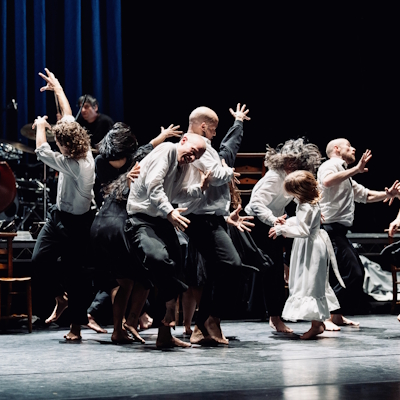
Photo David Gray
The dance shifts from moments of impressively together unison, to reeling and staggering around, to the creation of tableaux. Things constantly take unexpected turns. There are moments of uncertain humour, moments that have you smile but wondering whether you should be. One such sees one of the men rush around the stage, kissing every other performer, dancers and musicians. Everyone that is except one, who stands ready every time the man passes, but who is ignored time and again.
As MÁM progresses, layers are stripped away. The dancers remove their jackets and shoes. Even the girl loses her dress, ending in a white petticoat. The set peels away as curtains are removed, first revealing the ensemble, then the musicians of s t a r g a z e, then finally the backstage machinery, notably a large wind machine that blows a gale, sweeping the scene away.
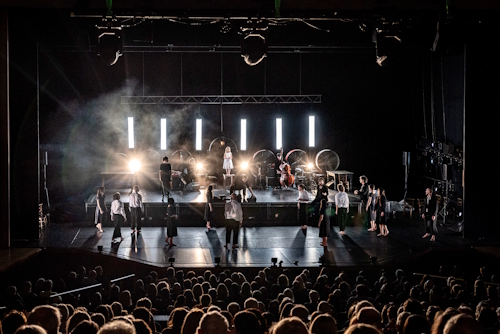
Photo David Gray
But it is carried by the music. It is quite simply terrific, Irish folk sitting comfortably alongside the contemporary sounds of s t a r g a z e. A jazzy section is particularly memorable.
MÁM is undoubtedly Irish, but not the clichéd or stereotypical Irish that is so often presented. But perhaps more than anything, it’s a peek into the human condition. A revealing of who we really are as human beings.
MÁM continues on tour to March 4, 2026. Visit danceconsortium.com for dates, venues and booking links.