

Omnibus Theatre, Clapham, London
December 4, 2025
Mountains and Seas – Song of Today (山海·今日之歌) is a new interdisciplinary work created by director Xie Rong (謝蓉), writer-performer Daniel York Loh, and composer-percussionist Beibei Wang (王貝貝).
The performance takes place in an intimate, almost compressed space. Audience and performers share the same plane, close enough to feel as if we have stepped into a rehearsal room rather than a theatre. Dancers Tash Tung and Fan Jiayi (范家宜) warm up quietly. Performers Xie Rong and Jennifer Lim stand nearby, each holding a different kind of focus: one poised, the other slightly restless. The musicians prepare at the side. He Song Yuan (何松遠), dressed in Beijing Opera costume, covered in small mirrored discs, periodically adjusts his long white beard with performative precision. Everything appears ready, yet the room lacks shared breath, shared rhythm. Everyone is present, though not quite occupying the same world.
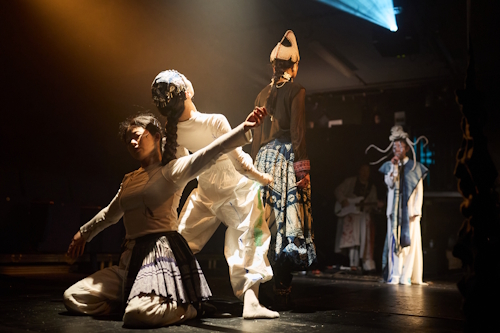
Photo Jamie Baker
The night unfolds under the weight of language. Loh’s script stretches in many directions at once, moving rapidly across the 4th-century BCE text The Classic of Mountains and Seas (山海經), ancient mythology, British politics, global extremism, climate crisis, personal grief, and fragments of self-narration. Each theme carries weight, each is vivid, yet the transitions lack connective tissue. The text behaves like a collection of fragments placed side by side, rather than ideas generating momentum from one another.
Dance is present throughout, though never quite integrated. Performed by Tung and Fan, the movement material is plentiful and visible, yet largely improvised in texture. It seldom forms a responsive relationship with the text, the music, or the imagery. Bodies move, yet the work itself does not shift. The dancers sustain their energy, though the density of spoken language continually thins the context in which movement might resonate.
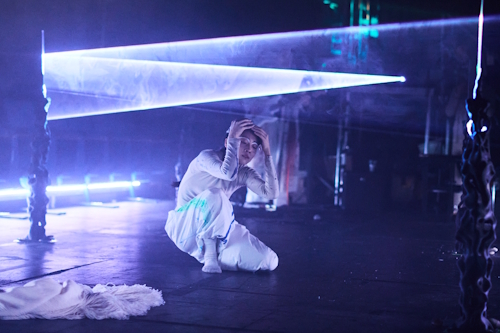
Photo Jamie Baker
The work attempts to contain many worlds, and gradually turns into a gathering without a centre. At times the performance feels like stumbling into a Cantonese teahouse, where guests enthusiastically trade stories, opinions, displays of skill. It is vivid, colourful, noisy, but the elements do not cohere. Nothing binds them into a shared theatrical language.
So it is with the text, and so with the movement. Loh jumps from mythology to politics to ecological anxiety; the dancers offer images and physical states, though these strands never form conversation or counterpoint. The material remains parallel rather than interwoven.
by Xie Rong and Daniel York Loh
Photo Jamie Baker
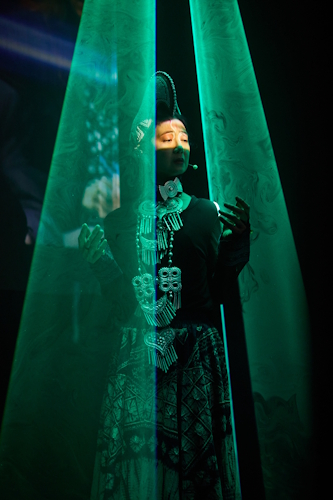
Under this combination of dense text and loose structure, the stage rarely finds direction. Language, movement, and visual motifs develop independently, without a rhythm capable of pulling them into a unified dramaturgy. The ingredients and intentions are not lacking, but the framework that allows them to generate theatre is missing.
A few moments do land. The clearest come from the music. Chen Yu Xiao (陳雨瀟), playing bamboo flutes and other wind instruments, brings a clean, focused tone that offers brief passages of breath and orientation. Her concentration provides the performance with its most grounded centre. Meanwhile, He, under laser light, lets his mirrored, disco-ball-like top scatter reflections across the room; paired with the handheld laser device. It creates the evening’s only image that approaches the mythic dream-space suggested by Mountains and Seas.
One of the most candid lines of the night arrives unexpectedly. “Close your eyes and clench your jaw. It will be finished soon and you will be free.” It is unintentionally honest, and it resonates more directly than many deliberate moments.
As the performance goes on, the audience response becomes consistent. People shift in their seats, check the time, attempt to refocus. The evening ends with polite applause. Warm enough, but without emotional charge.
I eventually found myself moving my hands softly in time with the music, creating a private counter-performance outside the stage’s unfolding. It was a way of staying awake, and of staying in rhythm.
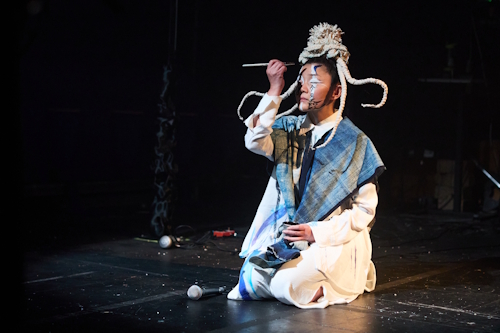
Photo Jamie Baker
As someone shaped by Chinese cultural heritage and long immersed in Western theatre, I could not find cultural weight in the evening. Its ‘Chinese’ elements do not feel rooted; its ‘Western’ elements lack grounding. The ancient does not deepen; the contemporary does not sharpen. The performance resembles a display window of cultural symbols more than a piece of theatre that generates relationships among them.
Perhaps what Mountains and Seas – Song of Today needs most is time and patience. The ambitions of the creative team are unmistakable, and the sparks within these fragments may yet find a more cohesive form. One can imagine a future version in which the line between mountains and seas becomes legible, and the many threads of the work finally begin to speak to one another.