

Radio Vinci Park by Théo Mercier & François Chaignaud, Utopia, Munich
ÔSS by Dançando com a Diferença & Marlene Monteiro Freitas, Therese-Giehse Halle, Kammerspiele, Munich
May 23, 2025
There aren’t many dance performances not scheduled to start until 10.30pm, and it was a good ten minutes after that when it finally got going. But Radio Vinci Park by director Théo Mercier and dancer-singer Francois Chaignaud was certainly worth waiting for. A sort of serenade, a work of myth, mystery and allure, of man and machine, it grabbed one from the moment one walked into the space to its engine roaring finish.
Entering the former drill hall, now a huge 1,200 square metre space used for exhibitions, concerts and other performance events, the disquieting, uneasy mood was immediately apparent. A bit of a chill in the air just added to the atmosphere.
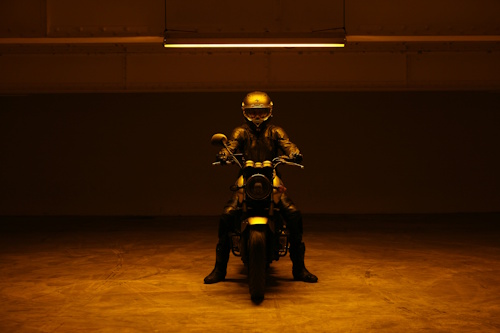
Photo Erwan Fichou
Seated at a harpsichord in a setting that seemed lifted from a faded bourgeois salon, Marie-Pierre Brébant plays Mozart and Purcell, pages from her scores scattered on the floor around her, he notes filling the space. Some sort of prelude to romance, perhaps. Well, yes, in a way, although the rest of the gloomy setting suggests otherwise, and especially when you look into the far distance and espy the barely discernible and somewhat ominous shape of a motorbike and its helmeted, black-clad rider, Cyril Bourny.
Into the scene arrives Chaignaud. As an artist, he’s taken up a multiplicity of roles including dancer, singer, actor and cabaret artist, all of which appear in Radio Vinci Park. Gender-neutrally dressed in white and wearing heavy ornaments on his ankles and wrists, he advances on the motorcycle. As his voice echoes around the space, his dance of seduction begins.
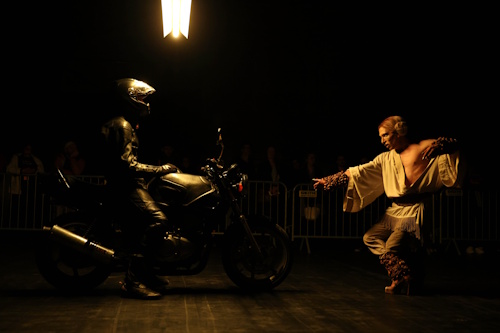
Photo Albert Vidal, Vertex Comunicacio
Initially using primarily his voice, it feels like Chaignaud is tearfully pleading with the object of his desires. Has he been spurned? Has something happened and he’s been discarded? Whatever, you sense that he’s dicing with danger here, that there is only so much this creature, the object of his desire, is going to take. A tragic yet slightly comic figure, his dance has more than a hint of flamenco about it. Indeed, at one point, he produces a fantastic few seconds of machine-gun like footwork. It’s also easy to see the motorbike as a bull; calm now, but you feel slowly coming to the boil inside.
That feeling ramps up as Chaignaud, still singing, and in a desperate attempt to get a reaction, starts to get more physical. He climbs on the bike. First over the handlebars, then a headstand on the petrol tank. Then clinging to Bourny, who remarkably continues to remain still, balancing the machine perfectly. It’s just a little unfortunate that the tension and emotion is broken occasionally by what feels out of character silly tapping by Chaignaud on Bourny’s helmet with his long fake fingernails.
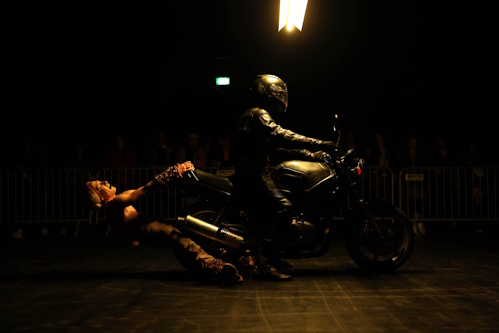
Photo Albert Vidal, Vertex Comunicacio
Perhaps that was the final straw because soon afterwards, the bike roars into life. It’s loud. Very loud. The tension mounts quickly. The animal that is the machine has been awakened. And it’s angry. It prowls around the arena, first circling Chaignaud but then charging straight at him, coming to a screaming halt just inches from him as he lays on the floor. But Chaignaud is not giving up yet. He hangs onto the back of the machine and lets it drag him across the floor of the arena. He could let go but no. And he’s still singing. But not for much longer as he’s left alone, empty, abandoned.
It all makes for a strange but also rather beautiful work. A lot of Radio Vinci Park’s appeal is to do with the contrasts of light and dark, Chaignaud’s fragility and the power of the machine. But what makes the performance most of all is the way Mercier and the magnificent performers, especially the figure of the lover, so brilliantly embodied by Chaignaud, build the tension. It may have been approaching midnight, but it was a terrific way to end the day.
Meaning was altogether more obscure in the evening’s preceding show, ÔSS, choreographed by Marlene Monteiro Freitas for Dançando com a Diferença, an inclusive dance company from Madeira under the direction of Henrique Amoedo, at the Munich Kammerspiele’s Therese-Giehse Halle.
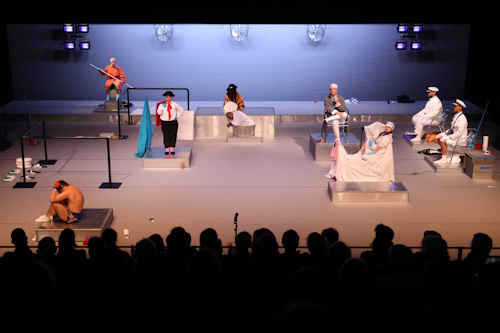
Photo Albert Vidal, Vertex Comunicacio
Having begun as a pilot project in 2001, Dançando com a Diferença is now a fully professional company. One of Europe’s foremost inclusive art organisations, it has presented over thirty works, many by well-known choreographers, and has performed in over seventy cities worldwide. It has several objectives, most importantly, to bring together on stage people with and without disabilities for a single cause: to dance.
But what is dance? While we might all have our own ideas, there almost certainly is not a form of words that fits all the possibilities. And there a lot of possibilities in OSS, a work of incredible innovation, creativity and daring, where everything is in a state of flux, nothing remaining what it seems for very long. It is quite crazy, even a little absurd, but all in the best possible way.
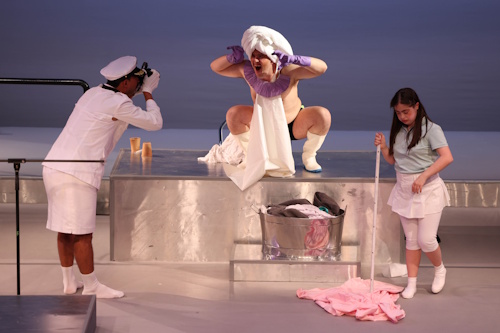
Photo Albert Vidal, Vertex Comunicacio
The title of the work means bones in Creole, which structure and support the body, while in karate it refers to pressing, pushing, and supporting. The work itself is described an exploration of the firm and the soft, internal organs and the skin, which the performers investigate choreographically. The perspective on bodies is also intended to inspire those watching to view bodies from beyond societal ‘norms.’ Whether any of that is particularly visible is questionable, but it is great fun.
It’s a true ensemble piece, each of the nine performers, most of whom embody several characters having their moments when they take centre stage. Even the setting seems to change. The white officers’ uniforms worn by two of the men, one of who seems to like to take photos of everything, suggest a cruise ship as indeed do parts of Yannick Fouassier’s set. Or is that me making associations that are not really there? But then white coats put us in a hospital. And there is a birth.
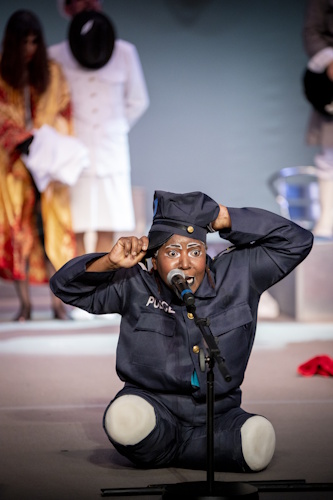
Photo Albert Vidal, Vertex Comunicacio
As the playful scene opens, among the many eye-catching sights is Mariana Tembe squished into a washtub, like a baby taking a bath. You wonder how she does it. All is revealed when she extracts herself, scooting across the floor, becoming a police officer. A tragic accident at the age of eight left Tembe without her lower limbs. That didn’t stop her learning to dance. Just like British dancer David Toole, who sadly passed away way to soon, not only does she move with incredible grace and speed, she has that wonderful quality of power. Even when just staring at the audience, she demands to be watched.
Among the amusing sights is that of a bald figure who not only has a second face painted on his crown like Akram Khan in Desh, but also another on the back of his head.
But there are disturbing moments too. Why do microphones become rifles? Never fired, but even so. Distorted voices heard from time to time add to the unease. The only certainty is uncertainty, it seems. Just what is this strange world?
Towards the end, the cast come to rest, everyone apparently asleep. Tambe sings a love song. Her voice may be distorted but its beauty and feeling are undeniable. But like everything else, nothing lasts. Interrupting herself, she asks cheerfully, “Is there a doctor in the audience?” For them or us, you muse. And then, “Do you know how to castrate a pig?” As we laugh hesitantly, she proceeds to give a graphic description. There is much more. So much, I feel sure I missed some things.
ÔSS is so crazy that you walk out wonder what on earth it was all about. What have we all just witnessed. What did it all mean? But does it matter? Does everything have to have meaning or be crystal clear? Because it is brilliant in its madness. Reflecting afterwards, one thing that was crystal clear was the quality of the work; and that of the superb ensemble of performers, however.
More International DANCE Festival München reports:
Opening speech by festival director Tobias Staab and deader than dead by Ligia Lewis
LA(HORDE) in The Master’s Tools
More to follow.