
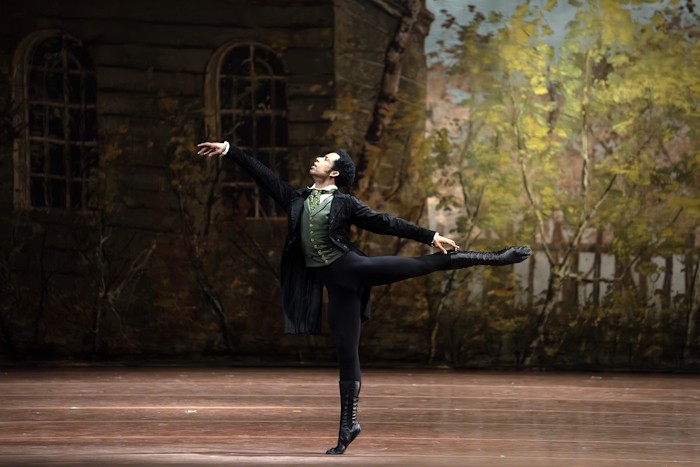
Bayerische Staatsoper, Munich
February 28, 2026
John Cranko’s Onegin, based on Alexander Pushkin’s verse novel Eugene Onegin from 1833, is always big drama. Performed by top dancers it turns into even bigger drama. On the last day of February, the Bayerisches Staatsballett demonstrated that high technical prowess combined with eminent acting can create a tale in which the characters turn into human beings, real people who hit you viscerally with all their anguish and throes. This is what dance can do at its best. No words needed.
In Madame Larina’s idyllic country garden, the women dance. Olga, Violetta Keller, making her debut in the role, floated weightless in the air in her duet with Julian Mackay’s Lensky, who excelled with his high jumps. It was an exuberant expression of a young, budding love. When Onegin, Osiel Gouneo, enters, you instantly realise he is troubled. Dressed in black, he stands out against the flurry of pastel-colored dresses disrupting the atmosphere of gay merriment.
Courteously, Onegin offers Tatiana, Laurretta Summerscales, his arm for a walk, but as soon as they are alone, he withdraws into his inner world of demons with such agonising pain that even Tatiana shies of approaching him. Nevertheless, she is attracted to him.
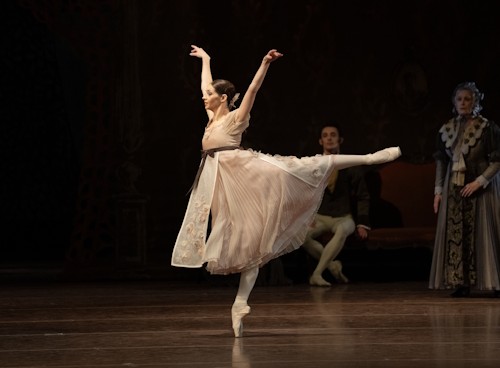
Photo Emma Kauldhar
In the ball scene, those demons take over. After having torn up Tatiana’s letter, he dances with Olga, a duet that increasingly looks like a dance with the devil. As the tempo increases, he pulls and tugs at her like a maniac, and they both lose their noble posture.
After the duel, during which Onegin kills Lensky, you literally see how his whole being, full of despair, torn apart. In the concluding scene with Tatiana, he partly pleads with her, partly forces her to dance with him. His happiness is palpable, when she reluctantly gives in. But when she sends him away, he leaves as a broken man; one who has lost all his dreams and hopes.
Summerscales was adorable; a bookworm, naïve and innocent. This was stressed in the amusing scene in the bedroom. Tatiana, having been tucked into bed by the nurse, rises, only to have to jerk back under her duvet as the nurse glances back. They repeat the scene making the audience laugh. The intermingling of such real-life moments is typical of Cranko and makes even his most dramatic ballets very human.
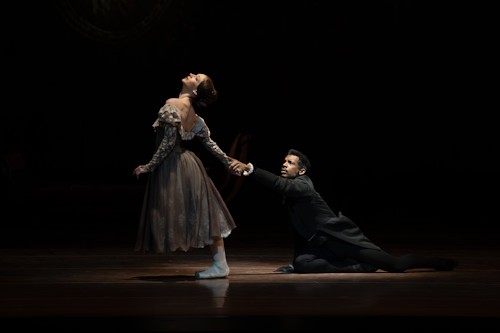
in John Cranko’s Onegin
Photo Emma Kauldhar
In the ensuing dream scene, Tatiana conjures up a loving man, without resemblance to the Onegin she met in the garden. Gouneo carried Summerscales as if she was weightless in high lifts. The couple seemed to float in an ethereal realm, a feeling enhanced by Jürgen Rose’s masterful set. His designs win time and again. Tatiana’s bedroom has no confining door, fo example. When the nurse leaves, she seems to disappear into a vast nothingness.
Tatiana’s devastation when Onegin tears up her letter stands in strong contrast to her relationship with Prince Gremin, danced with noble dignity by Matteo Dilaghi. At the ball they treat each other with mutual respect and affection. He holds her in his arms, she rests her head on his chest. Their every step seems to reflect a deep, mutual love.
The peace and quiet Tatiana seems to have found with Prince Gremin is shattered by Onegin’s letter. When he comes to her, she at first pulls away from him, resisting his pleading. But every time he embraces her or tugs at her, her resistance dwindles, until at the end she gives in, and brings back the feelings she once had for him. Only to then send him away once and for all. Throughout the scene, Gouneo and Summerscales were amazing, their psychological development and emotional expressions so convincing. Particularly impressive was Summerscales’ picture of deepfelt grief, but perhaps also anger, because Onegin dared to once more disrupt her life.
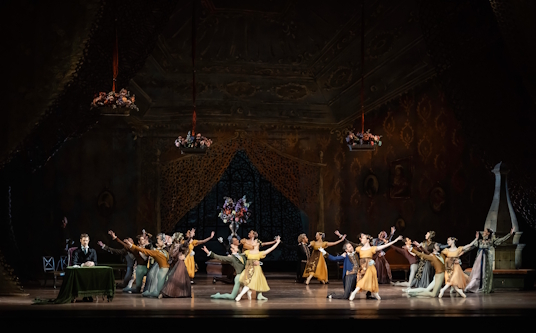
Photo Nicholas Mackay
From being a care-free, love smitten young girl, Keller’s Olga turns into an obstinate brat, who does not realize what Onegin is using her for. Mackay’s Lensky, who thought he was with a loving girl, has no clue as to why she is dancing so provocatively with Onegin. He tries to reason with her, unsuccessfully, and full of despair and anger, he ends up challenging Onegin to the fatal duel. The scene with Lensky, Onegin, Olga and Tatiana in the woods just before the duel, is a stomach-churning display of anguish, despair, fear and regret.
The rest of the company were in best form too. This was one of those evenings when everything came together, the dancing just a means of expressing unfathomable emotions, tearing the characters apart. They were helped by the Bayerisches Staatsorchester conducted by Marc Leroy-Calatayud, who turned Tchaikovsky’s score into a sea of passionate feelings. It was dancing at its very best.
Read Jeannette Andersen’s conversation with Onegin set designer Jürgen Rose here.