
Linbury Theatre, Royal Ballet & Opera, London
March 6, 2026
On the stage of the Linbury Theatre at the Royal Ballet and Opera, Ballet Black marked its 25th anniversary. Founded in 2001 by Cassa Pancho, the company began with the radical idea to create opportunities for dancers of Black and Asian heritage in British ballet, where such presence had long been rare. A quarter of a century later, the company has grown into something far more substantial, a distinctive voice within the UK dance landscape, known not only for its mission but for the individuality of its dancers and the choreographic worlds created around them.
This anniversary programme brings together two works that, in different ways, speak about hope and togetherness. Yet the evening reveals that these words can carry very different meanings. Hope Boykin’s …all towards hope looks toward community as an aspiration, a call to move forward together. Mthuthuzeli November’s Ingoma, by contrast, grows out of historical trauma and collective survival. Between them, the programme unfolds as a conversation about what hope might mean, and what it takes for people to stand together.
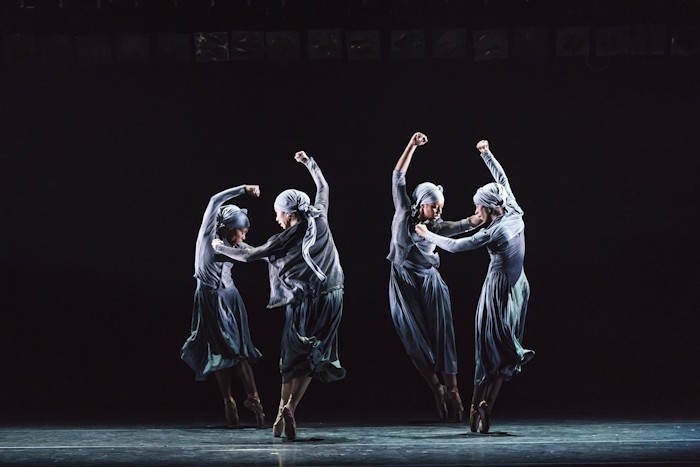
The first voice in this conversation is Hope Boykin’s …all towards hope, a work framed by spoken text written and recorded by Boykin herself that returns several times throughout the ballet. The voice reflects on what it might mean to move towards hope, repeating words such as ‘together’. At times the tone sounds declarative, as if offering a path forward; at others it seems almost to question whether such a path is truly possible.
The choreography begins with the group, but quickly shifts into a state where individuals move within the collective while remaining distinctly separate. Duets and solos emerge from the ensemble, offering moments for individual dancers to surface before dissolving again into the group. These sections do not always resolve into a clearly stated idea, yet they provide space for the dancers’ personalities and abilities to appear.
There are choreographic details that catch the eye. At one point the rolling notes of the piano are translated into small turning jumps, the dancers’ bodies echoing the music with a playful precision. Yet the work’s flow is repeatedly interrupted by blackouts between sections, creating a sense that the piece unfolds in fragments, not as a continuous movement.
It is only in the final section that the atmosphere shifts decisively. A strong rhythmic pulse takes over and the dancers move together with an infectious energy that feels like a rave or a communal ritual. The stage fills with motion and momentum, and suddenly the idea of togetherness becomes tangible. If the work spends much of its time speaking about hope, it is here, in the shared rhythm of bodies moving together, that hope finally becomes something the audience can feel.
The second voice comes from Mthuthuzeli November’s Ingoma, created for Ballet Black in 2019 and shaped by history and collective memory. Inspired by Gerard Sekoto’s painting Song of the Pick and connected to the Marikana miners’ massacre, the piece carries a very different weight. Here, togetherness emerges under pressure, forged through labour, grief and endurance.
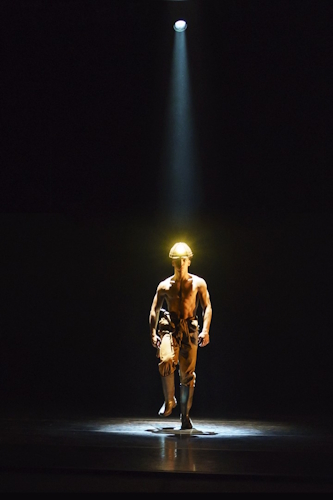
Photo courtesy Ballet Black
The opening duet unfolds to the rich sound of the cello, its long, resonant lines giving the movement a sense of depth and resilience. Soon the stage fills with rhythm: stamping feet and the sharp sound of hands striking legs create a powerful percussive pulse rooted in African dance traditions. Dancers run with high driving steps that resemble marching, their bodies suggesting the collective force of workers moving together.
One extended section of group dancing builds extraordinary momentum. The energy rises from explosive intensity into a sustained endurance, as if the dancers are pushing through exhaustion side by side. In the midst of this sequence, Helga Paris-Morales draws the eye. Her movement begins with striking clarity and strength, every gesture sharply defined. As the section continues, she begins to tire, her breath becoming visible and the edges of the movement softening. Yet she remains beautiful. The shift from precision to effort becomes unexpectedly moving to watch. The beauty here lies in persistence.
Lighting plays a crucial role throughout. The miners’ headlamps carve narrow beams through the space, turning the stage into a landscape of searching light. At times the beams sweep towards the audience, inviting us to look into the miners’ world while also reminding us that their gaze can meet our own.
The work is accompanied by a prayer spoken in Xhosa. For those who do not understand the language, the words drift through the space as sound and rhythm, carrying a sense of ritual and gravity. The unfamiliar language draws the listener closer, inviting curiosity about the world the dancers inhabit.
The double-bill also offers a chance to look closely at Ballet Black’s dancers themselves. In …all towards hope., Isabela Coracy immediately draws attention with her striking musicality and ease of movement, her dancing moving easily between balletic line and contemporary articulation. Magan Chiu, the smallest figure on stage, brings a surprising explosive energy, her compact frame generating bursts of power that cut clearly through the ensemble. Acaoã de Castro provides another contrast, his long lines and calm control lending a quiet elegance to the stage. Watching the company as a whole, what stands out is the range of physical qualities that coexist within the group, each dancer bringing a different tone to the stage.
And it is the dancers themselves who are at the centre of the evening, moving between very different choreographic worlds yet holding the stage with unmistakable presence. Whether in Boykin’s reflective search for connection or in the relentless collective momentum of Ingoma, their bodies carry the emotional weight of the programme. Twenty-five years after its founding, Ballet Black remains defined not only by its mission but by the performers who give that mission life on stage.