
Susie Sainsbury Theatre, Royal Academy of Music, London
December 14, 2025
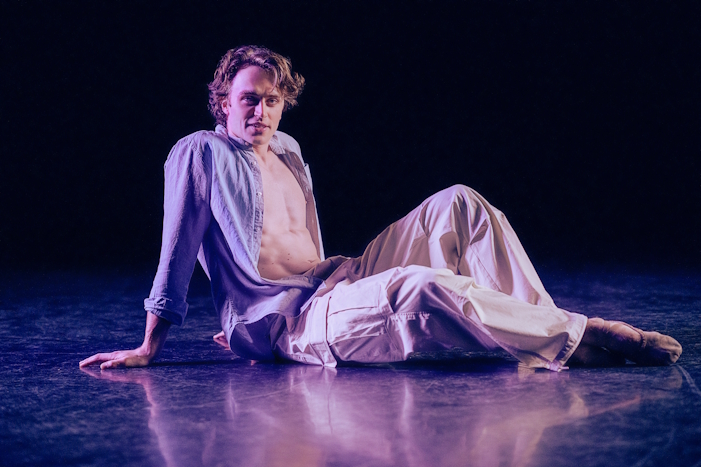
An Evening with Matthew Ball resists easy categorisation. Neither performance nor talk, it functions as a self-portrait in transition, part experiment, part public reckoning. Taking place on Ball’s 30th birthday, the evening reads less as a celebration than as the announcement of a rebirth in progress, an artist stepping forward while still assembling his voice.
Presented in the intimate Susie Sainsbury Theatre at the Royal Academy of Music, the evening sheds the distance of the main house and places Ball within reach of the audience, where dancer, choreographer and individual momentarily align.
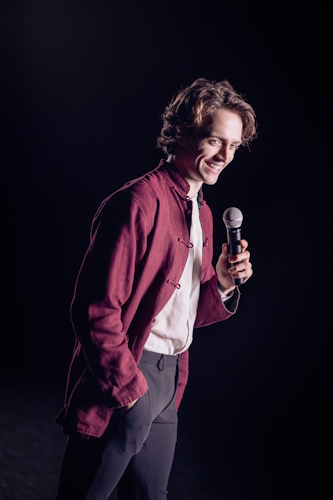
Photo Viktor Erik Emanuel
The evening opens with The Measure of Things, a solo choreographed and performed by Ball himself, set to Beethoven’s Piano Sonata No.31. Dressed in black, he enters a sharply defined square of light, holding a long metal pole. The image is immediately legible: light sets a boundary, and the pole becomes the means of touching it. Tool, weapon, support, measure. He uses it to test space, resistance and limit.
The solo reads as introspective, slightly tentative. A body checks itself against the world, asking where it stands and how far it might move. Ball later describes the pole as an almost accidental discovery, yet onstage its logic is exact. The interest lies in process rather than polish. What emerges is an artist in an unfinished state.
After a conversation with Kim Brandstrup, Ball moves into a ‘walk and talk’ through Albrecht’s Act II solo from Giselle. From a dancer’s perspective, the demonstration is compelling. His technical command is striking. His pirouettes show textbook spotting, a stable axis and precise control of centre through transitions.
Years of disciplined training are evident in how little effort is displayed. It is a body that does not need to push expression. Meaning can emerge through precision alone.
Yet as he speaks, I find myself waiting for something else. What Ball offers here is largely a discussion of ‘how’: breath, phrasing, spatial orientation, physical difficulty. What does not quite arrive is the ‘why’ I am listening for. Not motivation in a general sense, but the inner necessity that turns technique into dramatic action: why this movement must exist at this moment, and why it carries this particular quality.
That absence stands in contrast to an earlier moment in the evening. In speaking about Cupid and Psyche during the conversation with Brandstrup, Ball is able to articulate his thinking with clarity. He starts from conditions: Psyche is forbidden to see Cupid; everything unfolds in darkness; each movement risks disturbing the air. From there, the logic of movement follows. Action is shaped by fear, restraint and awareness of absence.
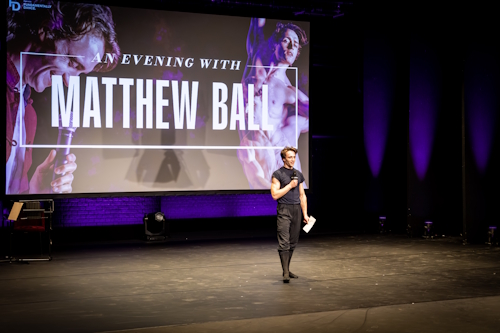
Photo G.S.
Seen through this lens, Ball’s Giselle demonstration reads differently. The understanding is there. It simply has not yet found its voice when he speaks about his own work. He can embody narrative complexity, but articulating it aloud remains part of a developing process.
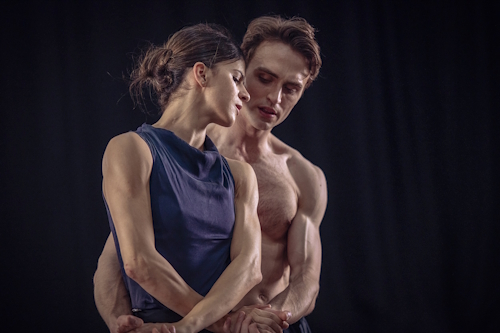
A brisk Q&A punctuates the evening, the room warm and eager, some questions disarming, others catching Ball off guard, before the night shifts back into movement with Waveform, a trio created by Ball and performed live, set to the second movement of Dvořák’s Piano Trio No.4. The work grows from his interest in sound as vibration, and in the visual patterns produced by frequency and resonance, translating into pendulum-like motions and shifting geometries formed by three bodies in space.
At moments, the choreography recalls Balanchine in its clarity and musical responsiveness. The partnering is inventive, occasionally edging into acrobatic territory. Technically, the dancers are excellent. Ball’s handling of musical texture is thoughtful. Mariko Sasaki reads as the piano line, Luca Acri as the violin, while Ball himself grounds the structure like a cello. The choreography intertwines convincingly with the score, though compared with Cathy Marston’s Against the Tide, it carries less dramatic tension. What it offers instead is structure, pattern and genuine curiosity about form.
(taken at Ballet Nights 007)
Photo Viktor Erik Emanuel
As the evening closes, Ball thanks his partner, Mayara Magri, and the tone softens. It is a quiet moment, without performance. What remains is the impression of someone willing to be seen mid-process.
This is a dancer who has mastered his instrument and is now learning how to speak about what that instrument carries. He is still searching for his choreographic voice, still finding language for instincts he already knows how to embody. To witness that process unfolding in public feels like a privilege.