
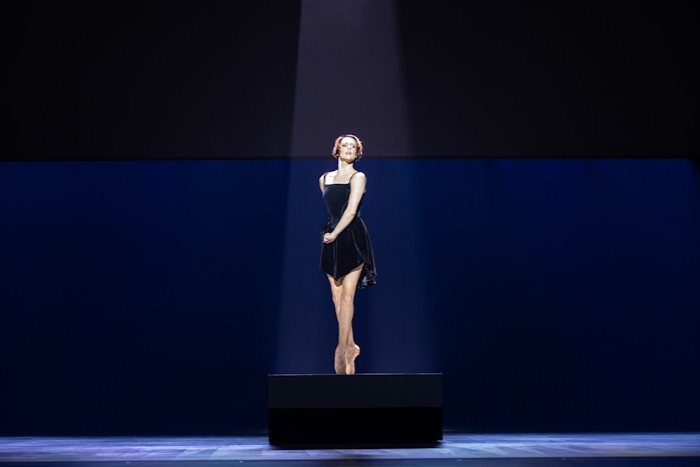
Sadlers Wells, London
March 5, 2026
If you are looking for a Scottish subject for a historical ballet, they probably don’t come any meatier than Mary, Queen of Scots, whose marital situation and political actions triggered rebellion among the Scottish nobility, forcing her to flee to England, where she was immediately imprisoned by her cousin, Queen Elizabeth I, and eventually beheaded.
Mary’s story is complicated. Her relationships complex. When adapted for ballet, they feel even more so. Thankfully, Sophie Laplane’s ballet, premiered at the Edinburgh International Festival in 2025, comes with a detailed synopsis, which is very helpful.
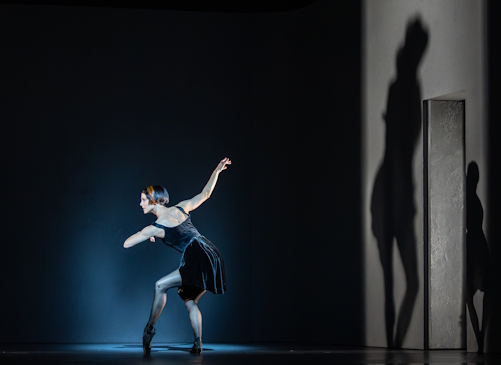
in Sophie Laplane’s Mary, Queen of Scots for Scottish Ballet
Photo Andy Ross
The scene is set with a dying Queen Elizabeth I immersed in her memories of her cousin, which are then played out over the next couple of hours. The dancers were superb, their level of technique, dramatic interpretation, and musicality, a sheer joy to watch.
Charlotta Ofverholm, dancing the older Queen Elizabeth, was the outstanding dancer of the evening, portraying a old, dying queen tormented by memories of what she had done. Roseanna Leney danced Mary with conviction, and Madeline Squire was an excellent Catherin dd Medici, rising above her rather bizarre costume, which could have easily swamped her.
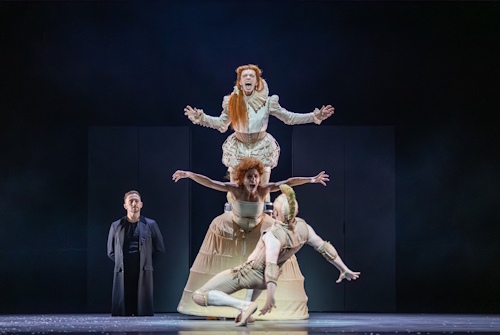
and Harvey Littlefield as Younger Elizabeth in Mary, Queen of Scots
Photo Andy Ross
The men were slightly less convincing, with Bruno Micchiardi’s Rizzio, a key character in Mary’s life, getting lost rather. The addition of a jester, in a narrator role, was very well danced by Kayla-Maree Tarantolo, but the character feels out of place, and is of no help in guiding us through the story. Indeed, one wonders what the point of the figure is.
The choreography, indeed, in many ways the whole ballet, is a fusion of classical and modern. Laplane threads innovative and creative moves together with a fluid languidness, which is just right for the overall mood of the piece and matches the music to perfection. There is some repetition, but always for a purpose.
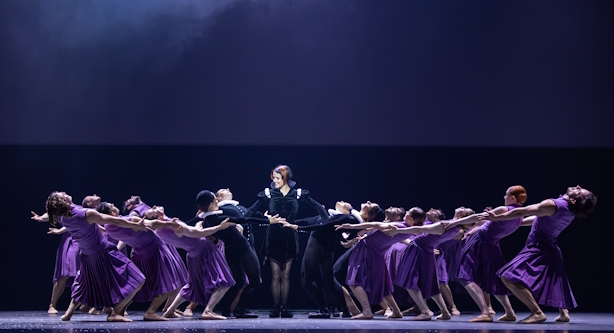
Photo Andy Ross
The original music by Mikael Karlsson (much in demand by choreographers right now) and Michael P Atkinson is interesting, dramatic, tonal, but hugely repetitive. There is so little change in pitch, pace or feel, that the dancing almost becomes subsumed by it, the flow of the ballet absorbed by the music.
Soutra Gilmour’s set design is clever and serves the ballet very well, effortlessly creating the different environments of Mary’s life, including a sea voyage. Her costumes are more of a mixed bag. Elizabeth goes from underwear to full Elizabethan costume and back, while Mary appears in what looks like a little black cocktail dress, with an over-jacket very redolent of the period. The jacket was quite classy, so a shame she did not wear it for long.
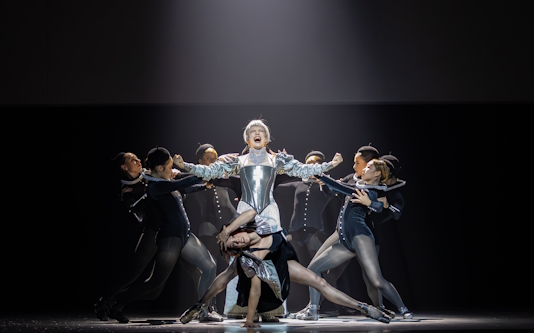
and Roseanna Leney as Mary (floor)
in Sophie Laplane’s Mary, Queen of Scots for Scottish Ballet
Photo Andy Ross
The leading male characters are in simulated doublet and hose, and the four Marys (the women, all named Mary, who accompany the Queen from France to Scotland) in black shifts and neck ruffs. The jester is traditionally dressed in bright green. The members of the court, men and women, also come in black, but with very odd face masks that make them look for all the world as if they had wandered onto the stage from the set of Star Wars.
So, what was the overall impression of this new ballet? It’s certainly beautifully choreographed and danced, and the set is perfect. Given its complexity, the story is probably as clear as you are going to get. And there is a lot of story. For me, the costumes don’t quite feel in in-tune with the mood of the ballet, though. And the music seems to be a constantly repeated refrain, much in need of light and shade, pace and difference. All of this said, Mary, Queen of Scots holds together well, and is interesting and powerful to watch.
It will be interesting to see how the ballet develops, what changes, if any, are made. But with a few rethinks and revisions here and there, it will surely become a regular in Scottish Ballet’s repertoire.