The Place, London
January 20, 2026
After the performance ends, I take out the programme and read the descriptions again. They describe three bold worlds: endometriosis made visible, a mythic journey through time, fire as ritual and political force. What I remember is the labour of trying to enter them.
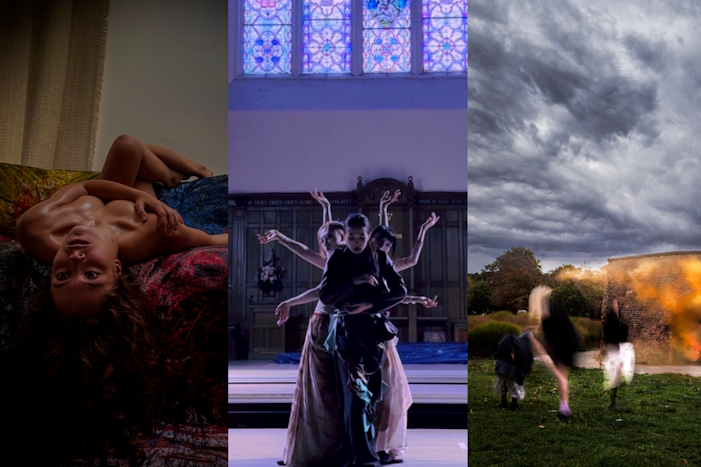
In Rotting Home, Hannah Todosijczuk enters before we do. By the time the audience settles, she already lies at the centre of the stage. Much of what follows barely registers as dance: rolling floorwork, shifting poses, slow sexualised walking, self-touch, direct eye contact. Her own recorded moans surface in the soundtrack during the floorwork. If the work aims to confront the male gaze, it keeps circling its language. It invites the gaze in, but never quite turns it back on the room.
That is why the moment that lands is the least performative one. A red line of light cuts in, the sound turns sharp, like fingers scraping the surface of a balloon, and her body spasms into something involuntary. Here, pain stops being presented and starts interrupting the performance. That is when the work finally feels real.
Six small paintings by her father hang above the stage, a quiet gesture of support. But they never spark on stage. They remain a private symbol, not a theatrical one, a missed opportunity for a dialogue that never ignites.
In Chronos by SynEcho, the concept is bigger than the choreography can handle. Cultural imagery and dramaturgy remain blurred, so I watch movement, transitions, and shifting groupings without ever finding a centre. Four dancers move through solos, trios, and quartets around a glowing orb that suggests sun or moon, but the work never gathers into a world I can enter.
There are theatrical hints of time travel. The white-shirt dancer repeats a sequence of twisting a lightbulb as the sound shifts from handwriting to typing, and later searches in darkness with a torch, as if looking for something lost. But these signs never develop into something legible. The programme offers a story. The stage asks me to guess it.
pyro by Kill Your Darlings begins with the sharpest idea of the night. Eliza Jean Scott enters as a witty Joan of Arc figure, and a ring of crushed plastic bottles crackles like fire as she delivers a deadpan lesson in health and safety regulations. It is smart, funny, and oddly precise: the absurdity of disaster rehearsed until it becomes routine.
Then the piece loosens into fragments. Movement slips between loose improvisation and brief unison phrases, performers step aside to sit and smoke, and the focus keeps drifting. At one point, a performer turns to accuse the audience: a fire is happening, and you are just sitting there watching. It aims for political bite, but lands as scolding without structure. A brief rave sequence follows, crisis as spectacle, before a dancer is covered in gold foil like a burnt body, echoing the earlier witch-burning image. The question remains unanswered: what exactly is this fire meant to burn?
Across all three works, the dancers are committed and the themes are ambitious. What I miss is not effort, but clarity. The evening often feels unfinished, as if each piece is still searching for the choreographic language that could carry its ideas all the way through.