
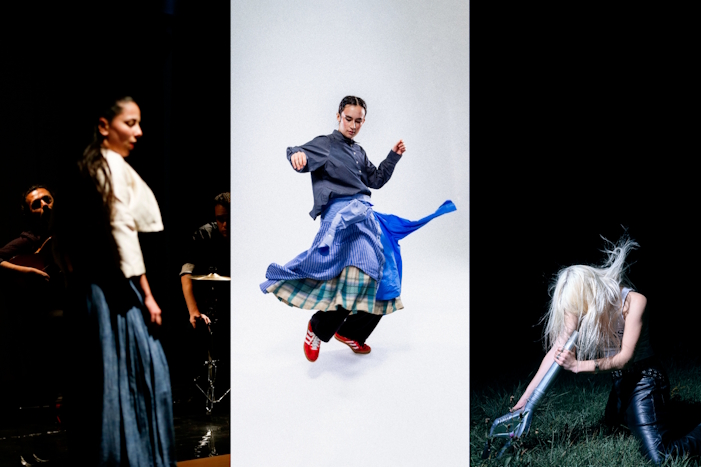
The Place, London
January 17, 2026
This Resolution programme at The Place brought together three works that approached dance from very different directions. Across the evening, movement functioned not only as performance, but as a way of listening, gathering and questioning. From shared improvisation to solo attention and sharply framed dance theatre, the works explored how bodies, sounds and ideas meet in real time, connected perspectives on what dance can do in a contemporary context.
This feeling is established immediately in Encuentros presented by Fin de Fiesta and choreographed by Lydia Ayllón. It begins before the audience has fully settled. As spectators enter, the performers are already present on stage, seated in a circle. There is no clear beginning between preparation and performance; the audience is welcomed into an ongoing gathering. Fourteen dancers and musicians from flamenco, contemporary, Indian and tap dance share the space as if in a communal jam, echoing the spirit of a London juergas, where flamenco traditionally unfolds as a social and improvised exchange, not only a staged product.
The structure of the work is open and responsive. The live music moves between flamenco and rhythm-driven percussion and melodic textures from different cultural traditions, shaping the atmosphere in close dialogue with the dancers. Musicians introduce rhythmic phrases, often grounded in an eight-count cycle, and dancers respond through movement. Sometimes the body mirrors the rhythm precisely; at other moments it stretches across it, catching only the main accents or playing against the beat. A tap dancer and Indian dancer find a shared language through footwork, their rhythms aligning and conversing with the musicians at the stage. Flamenco keeps the exchanges grounded, while contemporary movement allows the dancers to move easily between different styles.
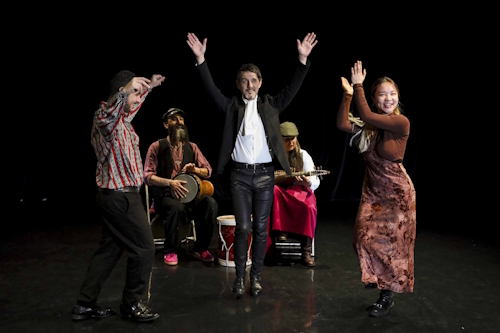
Photo Jemima Yong
The piece feels warm in the way performers take turns dancing and watching others. A solo expands into a duet, then briefly into a trio, before dissolving again as dancers return to their seats to watch other people performance. Performers join in when they are feeling drawn to dance, are invited by others, and step back again when the moment passes. Music and movement meet through the live music, with different dance forms entering into conversation as the performance develops.
Encuentros communicates a powerful idea: people come together through art, and dance/body can be a shared ground of understanding. It recalls the ancient notion that when words are no longer sufficient, the body speaks.
That sense of listening shifts focus in AD-LIB, a solo improvised work by Lauren Scott rooted in popping and hip-hop techniques.
As the music moves from jazz textures into electronic soundscapes, Scott steps into the space, responding with clear focus and control. The performance stays on the dancer’s ability to translate sound and sensation into movement. Isolations, small shifts movements show how the dancer follows the sound as it moves through the body.
Historically, street dance has been shaped by social exchange and battle culture, with freestyle as competition and self-expression. Here, that lineage is acknowledged but transformed. Removed from the battle context and placed within a theatrical setting, freestyle becomes an act of deep listening. The dancer does not perform to the music so much as with it, translating shifts in rhythm and texture into embodied responses.
Lighting and spatial focus heighten the sense of presence in the room, drawing the audience into a shared sensory experience. In doing so, the work successfully bridges street dance and contemporary dance theatre, keeping the raw immediacy of freestyle while allowing it to communicate beyond technical display.
The final work, Copters and Hearses, moves firmly into the terrain of conceptual dance theatre. Created by choreographer JJ James in collaboration with fashion designer Joca Veiga, the work offers a sharply defined critique of modern self-optimisation culture, consumerism and the illusion of fulfilment. The opening image of an angelic figure in the corner of the stage sets a symbolic tone that unfolds across the work, culminating in a striking final tableau: one performer skipping rope along a diagonal line while others kneel in ritualistic submission.
Costume and installation are integral to the choreography. Each of the six dancers wears a distinct outfit, suggesting different social archetypes and desires. Movement patterns are carefully structured: one dancer crawls along the edges of the space, one dancer sits on a sculptural structure, while duets shift between leading and following, with weight passing back and forth between bodies. The dancers shift between moments that suggest angelic devotion and others that tip into excess and distortion. Desire, guilt, labour and aspiration coexist within the same physical system. The clarity of spatial composition and performer placement gives the work a strong internal logic, allowing its critique to emerge through embodiment.
Copters and Hearses keeps returning to simple questions. What is left once the obsession with perfection has run its course? What cannot be optimized, commodified or replicated? The body, in its vulnerability and repetition, becomes both subject and evidence.
The evening offered a rich range of choreographic approaches. Each work felt clear in what it was trying to do and confident in how it did. They formed an evening that reaffirming Resolution as a space where emerging artists can not only present dance work, but also test how dance can speak, and listen, beyond words.