
The Place, London
February 5, 2026
This evening at Resolution 26 unfolded as a study in how bodies are shaped: by external forces, by collective energy, and by internal rupture. Across Echo of Me, Rooted, and Emanations of Disfigurement, three choreographic voices approached the body as something shaped by being watched, supported, strained, and remembered.
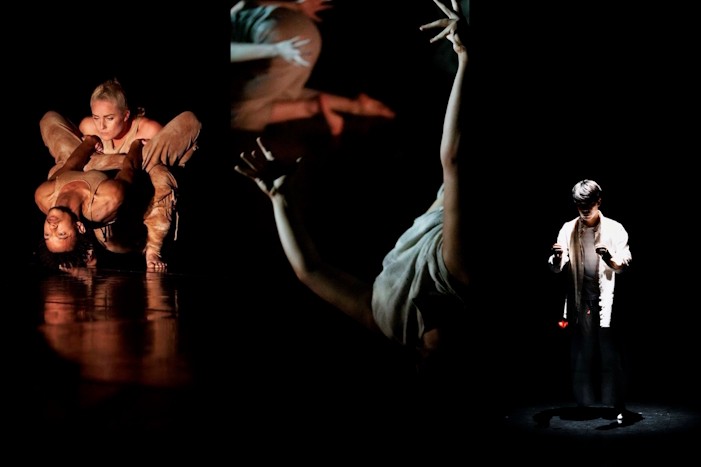
Echo of Me by MANACAN opens with a striking image. A dancer in red stands alone, her attention drawn toward a suited figure paired with a balloon-like prop. Through lighting and projection, their interaction casts shadows onto the back wall, creating the illusion of a duet that exists somewhere between reality and reflection. What we see becomes a dialogue between control and loss of control, between presence and projection.
Throughout the piece, the choreography stays with a single idea: moments in which parts of the body appear to move independently, slipping out of conscious control. These moments gradually develop into longer movement phrases, sometimes precise, sometimes playful, and occasionally edged with laughter. The choreography uses clear, recognizable actions, which makes the idea easy to follow and, at times, unexpectedly human.
The idea behind the work can only be realised by experienced, highly trained dancers. Everything comes across clearly, with the music adding strong support and enhancing the work as a whole.
That said, the transition from the opening solo to the later group sections could be more fluid. While the idea stays consistent, the connection between them could be clearer. Echo of Me offers a thoughtful exploration of how identity fractures and reforms under the pressure of being seen.
Where Manacan questions instability, Shea Sullivan’s Rooted commits fully to connection. Inspired by the underground networks through which trees communicate and sustain one another, the work pulses with vitality. From the outset, the dancers move with grounded strength, their weight sinking and rebounding as if drawing energy directly from the floor.
The lighting works closely with the movement, making the space feel alive. The choreography emphasizes flow, support and transmission. Energy passes visibly from one body to another. The dancers move with a strong sense of togetherness, staying connected to one another.
The piece is grounded in strong physical movement and offers something meaningful in its ideas. The strength of the piece comes from how it feels: the build-up of energy, the shared rhythm, and the sense of movement continuing over time. Rooted does not argue its message; it embodies it.
The final work, Emanations of Disfigurement by Chinese choreographer Jie Gao and Cambridge-based dance practitioner Wally Groves, both studying for their MFA Choreography at Roehampton University, shifts the atmosphere sharply. Performed on an open stage without black curtains on side, the dancers are fully exposed from the start to the end of the work. The dancers’ breathing is clearly audible, pulling the audience directly into the physical experience of the performance.
The piece begins with an image of containment: a dancer struggling to escape what feels like a theatrical cage. From there, the movement becomes increasingly intense, shaped by electronic sound, lighting. That lighting, with its striking use of colour, helps define the space and adds to the work’s visual impact.
Here, the choreography carries both narrative weight and emotional force, moving through trauma, anger and resilience. The movement is intense and direct, carried by performers who commit fully to its demands. Bodily memory comes through in the physical experience of the work, inviting the audience into a close, shared sense of feeling. The work allows moments of discomfort to sit with the audience.
This was an evening when The Place offered a varied selection of choreographic voices, each engaging with the body in its own way. Every work showed a different sense of direction, whether through ideas, energy or physical presence. The evening felt assured and carefully made by wonderful dance artists.