
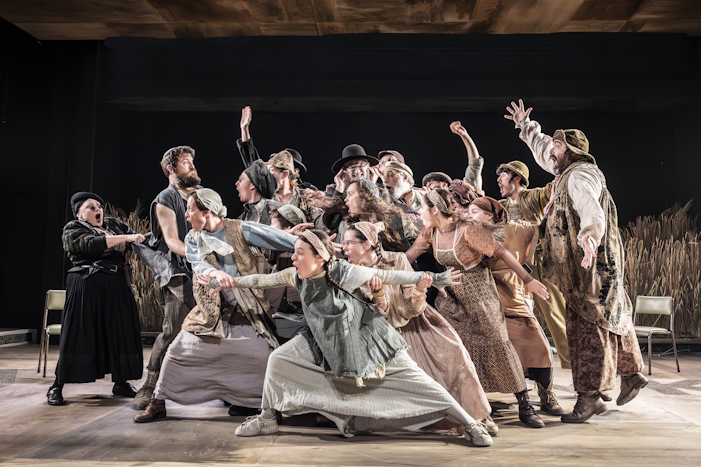
Alexandra Theatre, Birmingham
December 9, 2025
‘Tradition.’ It’s the title of the powerful opening number of Fiddler on the Roof and it’s easy to think that is what the show is all about: the long-suffering milkman Tevye and his fellow villagers battling to keep their way of life. But it’s about a lot more than that. There’s identity, community, faith, fear, repression, hopes and dreams, and, veined most deeply of all, the love Tevye has for his family. He just wants what is best for them, especially for his three daughters. The problem is, traditions are not fixed. As the world moves on, as attitudes shift and incomers arrive, change is inevitable, and Tzeitel, Chava and Hodel don’t quite see things the same way as their father.
With libretto by Joseph Stein, music by Jerry Bock and lyrics by Sheldon Harnick, Fiddler on the Roof came into being in 1964, going on to spawn a much-loved 1971 film starring Topol as Tevye, and numerous stage productions. It’s easy to see why it endures. The score is packed with memorable tunes that you just can’t get out of your head for days afterwards, and the story is touching, it also comes with a lot of humour.
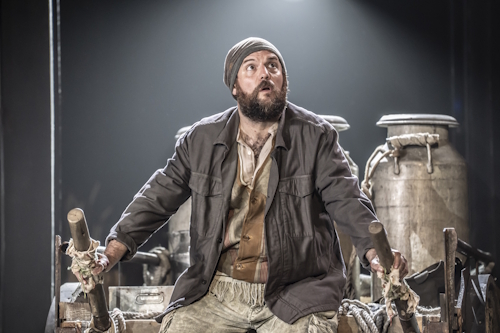
Photo Johan Persson
Based on a collection of short stories written between 1895 and 1915 by Yiddish author and humourist Sholem Aleichem, the musical is set in fictional Anatevka, where the Jewish community are under threat from the pogroms of Czarist Russia. These were violent attacks on Jews, organised locally, at the very least with the tacit approval of government and police, in which the perpetrators sometimes raped and murdered their victims besides looting their property as they forced them to move on. Such things have always happened, in all parts of the world, but today the show feels frighteningly topical. That Anatevka is situated in what is today Ukraine, only makes it even more so.
The opening is momentarily a picture of rural peace. A wheatfield. The sun shines. But as a violinist wanders among the crop, he plays a haunting tune. Already you sense that trouble is brewing; that the air is heavy and that a terrible storm loaded with antisemitism is not far away.
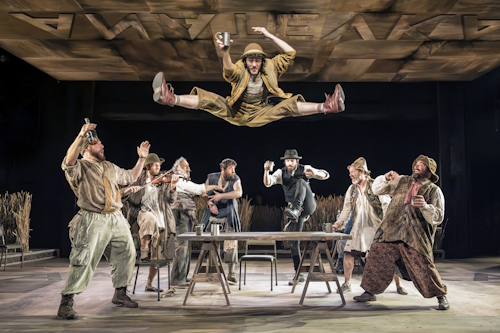
Photo Marc Brenner
It’s far from the usual Christmas fare, with Act Two especially dark. But director Jordan Fein and the wonderful cast balance the threat with moments of that make you laugh and smile.
The music and dance always come so easily out of the story. Julia Cheng’s choreography is terrific. Complex and often folk-influenced, although with a few near balletic moments, the big numbers are especially alive and full of energy. The ‘To Life’ sequence is among the best. But original choreographer Jerome Robbins is not forgotten, his ‘Bottle Dance,’ remaining joyfully intact. Very clearly from a different choreographic lineage, it sees some of the men put bottles on their heads and perform an remarkable series of steps that, in contrast to the rest of the dance, are mostly quite balletic, although there are some stomps and knee drags too. It’s a dance highlight.
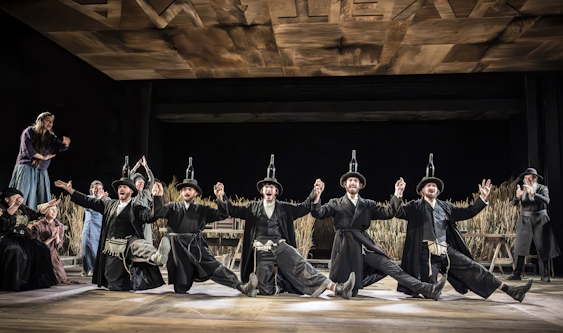
Photo Marc Brenner
Musically, the show and its excellent on-stage band deliver toe-tapping, hum-along number after hum-along number. There are the big ones like ‘Tradition,’ ‘Matchmaker,’ and of course, ‘If I Were a Rich Man,’ that everyone seems to know. Elsewhere, the beautiful and quieter ‘Sunrise, Sunset,’ and the sweet and full of feeling, ‘Do You Love Me?’ also pack a punch, just in a different way. The onstage band are very good, but why hide them in the wheatfield? From the stalls they are all but invisible, the viewer only aware of their presence thanks to brief glimpses of the conductor’s arm or the top of an instrument.
It is impossible not to like Matthew Woodyatt’ Tevye, a man who is strong, but not averse to a little dreaming now and again. He shows us all Tevye’s struggles to hold his family together, along the way showing his anger, his despair, his wit and his silliness, but most of all, his love. The conversations with God are especially funny.
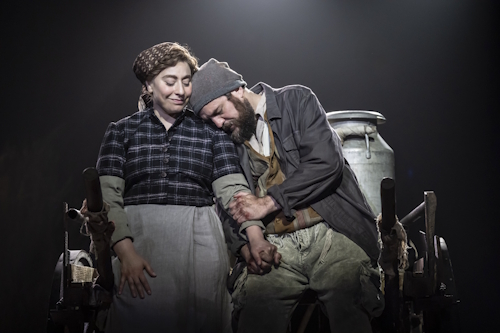
Photo Johan Persson
As Golde, Tevye’s wife, Jodie Jacobs gives us a woman at times exasperated, but with the patience of a saint. She needs it! There’s a lot of eye-rolling at some of the goings on. And she is just as much in love with her husband as when they first met as their tender duet, ‘Do You Love Me?’ demonstrates.
Central to events are three of Tevye’s daughters (he actually has five): Tzeitel, Hodel and Chava. Beverley Klein’s larger-than-life, meddling Yente may scheme away trying to find husbands for them but her and Tevye’s problem is that the sisters all have eyes on others; others who their father finds unsuitable. A pauper and a revolutionary he could probably just about handle, but a non-Jew? The conflict and emotions produced reflect the generation gap in any time.
The daughters are all beautifully fleshed out as characters, all clearly very much in love with their suitors. Natasha Jules Bernard’s Tzeitel, the eldest, goes from quiet and reserved to someone unafraid to let her emotions pour out as she falls for poor tailor, Motel (Dan Wolff).
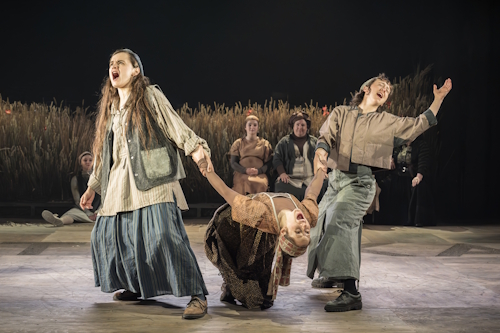
Photo Marc Brenner
Particularly difficult for Tevye is the relationship between Hannah Bristow’s Chava and the non-Jewish Russian Fyedka (Simon Anthony). As the ensemble separate her from her father, it feels like she’s being rejected, ejected by the whole community.
Best though is Georgia Bruce’s Hodel, who grows into a defiant young woman, determined to follow Perchik (Greg Bernstein) on his revolutionary journey. Her defiance of her father, who eventually succumbs, her strength, is radiant.
Rather cleverly, the production does actually have a ‘fiddler on the roof.’ Played by Roman Lytwyniw and appearing regularly, his music a mirror to Tevye’s emotions, adding layers to his actions and words. When they move together closely, it’s as if Teyve is dancing with his shadow.
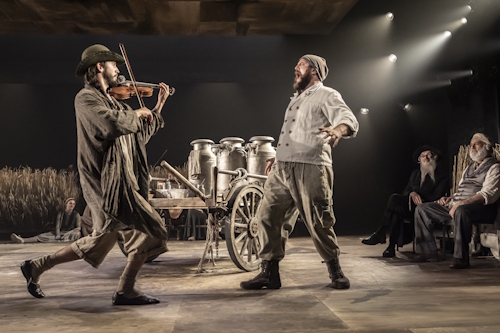
Photo Johan Persson
Right from the remarkable opening when the entire wheatfield rises to reveal the cast below, Tom Scutt’s sets are perfect. Using just a few tables and Tevye’s milkcart, shifted around by the cast, they easily take us to different locations. Aidden Malone’s lighting meanwhile takes the viewer easily from day to night, with real candles used for the celebration of the Sabbath and for Tzeitel’s wedding.
Fiddler on the Roof truly is a wonderful two-and-a-half-hours; a masterpiece of character and storytelling. Yes, the end, indeed most of Act Two, is frighteningly poignant, so much so it may well choke you up. Yes, it is painfully relevant to present times despite being created over sixty years ago. But it’s also full of great music, great dance, spirit and comes with a lot of heart. It’s a show you will not forget.
Fiddler on the Roof is at the Alexandra Theatre, Birmingham to January 3, 2026.

Photo Marc Brenner