
The Coronet Theatre, London
February 26, 2026
Last and First Men (2020) is a film directed by the late Icelandic composer Jóhann Jóhannsson, based on Olaf Stapledon’s masterly 1930 sci-fi novel of the same name and narrated by Tilda Swinton. It is this dystopian collaboration that serves as the backdrop and landscape for Adrienne Hart’s piece for Swindon-based Neon Dance, created in 2024 and revived this year at The Coronet Theatre.
Kelvin Kilonzo, Fukiko Takase and Aoi Nakamura are facially vacant and dressed in grey unitards. The 16mm film carefully advances through shots of memorial structures, grainy stone and dramatic curves. Swinton’s narration places us billions of years into the future where the human race is facing extinction.
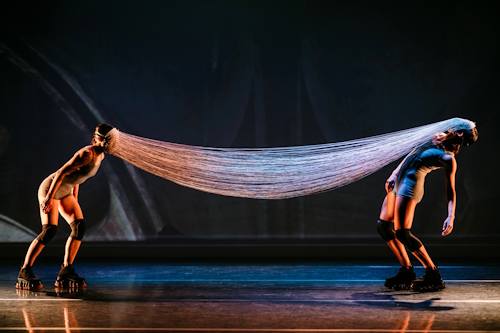
Photo Miles Hart
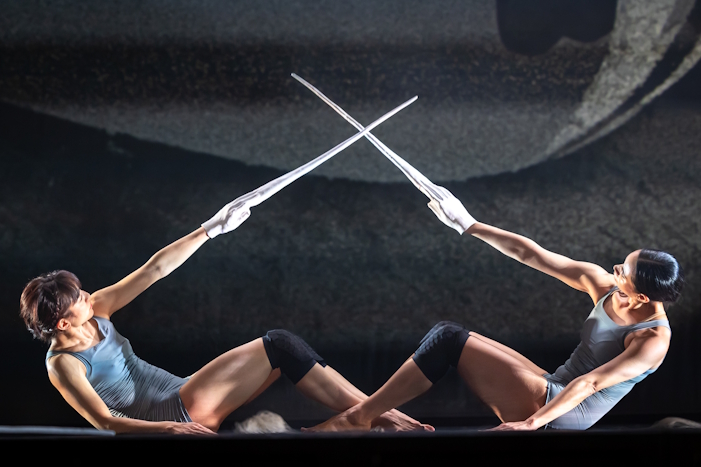
Kilonzo crouches downstage with two long white spikes protruding from his hunched torso, props that later facilitate a ritual. Between Takase and Nakamura, both on foot, runs long white string, attached to and concealing their faces. The pair move back and forth in a subtle pendulum, a movement like an aftereffect of some greater shift. For a while, dance is an understated visual addition to what already feels architecturally curated.
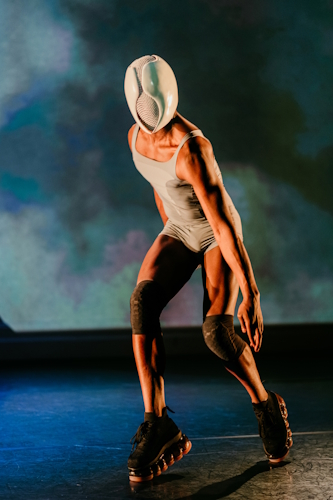
Photo Miles Hart
These ‘men’ probe the space with peace fingers as if communicating solely via their hands. The thick soles of their trainers lend well to a tip toe walk not totally removed from bipedalism as we know it, one feature of a movement language choreographed by Adrienne Hart in collaboration with the dancers and Makiko Aoyama.
Despite Swinton’s description of telescopic eyes and translucent skin particular to this Neptune-dwelling species, one moment in which the group comes together feels distinctly human, even if it is the cinematic film score, composed by Jóhannsson and Yair Elazar Glotman, that drives the emotions.
Kilonzo, Takase and Nakamura connect as the music expands majestically. The thread and tangle of their limbs creates shapes that evolve gently and inquisitively across the stage. Alongside Swinton’s pared down description of this species in their maturing phase, of loving and hating and learning, this scene evokes the turmoil and transitions of adolescence.
Movement is bound to the narrative script, itself adapted from Stapledon’s novel. Often the choreography unfolds as a literal reflection of Swinton’s descriptions, other times there is leeway for interpretation. The trio serenely sit cross-legged in their ‘collective mind’. Kilonzo is given a white helmet for interplanetary exploration, at which point he stutters and struggles on bent legs and the toes of his trainers. The species in their youth are perky and balletic. High extensions, neat feet and clean lines are broken by quirky elbows, knees, shakes and wiggles. Curiosity is felt in the extremity of their limbs, but their faces remain unemotional and the movement, strangely efficient.
One might wonder what dance can offer to an already mighty partnership of visuals, orchestral score and narration, elements that could easily stand alone in their own right. The visuals of monuments resonate with the absence of human presence. Swinton’s voice is coolly disembodied, and more ominous for it, and the orchestral score sweeps time and space with existential and intangible breadth. The dancers, then, are welcome in their physical presence, their serenity and physical control impressive. Beyond this, however, their bodies merely populate a landscape of visuals Jóhannsson had chosen for their emptiness. Movement, as the final layer to this unity of art forms, relies on these other elements to land; the film doesn’t need the dance in return.