
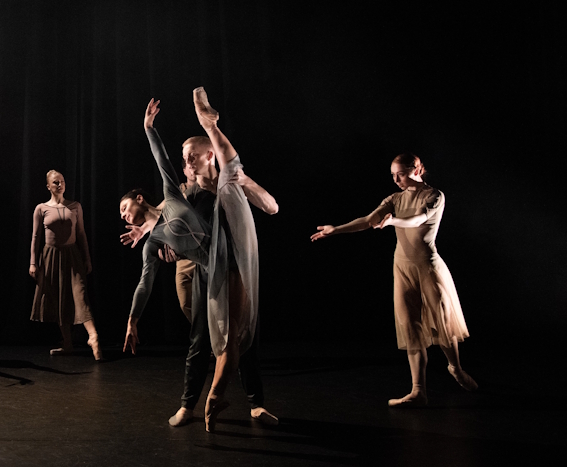
JW3, Finchley, London
February 8, 2026
BalletMAR, the young classical ensemble led by Marika Brussel and Richard Bermange returned to the London stage with three contemporary ballets that reimagined history and Jewish narratives. All rather appropriate as the performance was in the impressive 265-seat Howard Hall at JW3, the Jewish community and arts centre in Finchley.
Richard Bermange’s solo piece, Mr Greentree (My Wish Was My Command), is a multimedia work inspired by and that celebrates Austrian-Jewish cabaret artist and anti-fascist Fritz Grünbaum. Part history lesson, part dance performance, the ballet is a very adept and effective coming together of film, text and choreography. So much so, that it makes you want to go away and discover more about the artist.
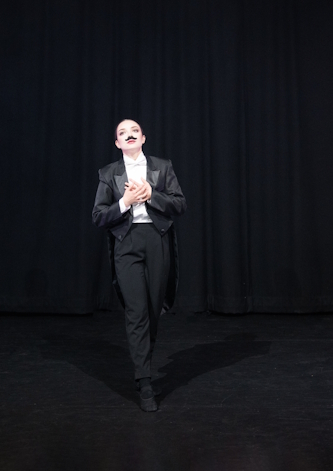
in Mr Greentree (My Wish Was My Command)
by Richard Bermange
Photo Lynn Pryor
Text is used extensively, the work opening with three text-heavy slides detail Grünbaum’ life and work. Those slides do provide useful background though, telling us how he was very much part of cultural life in Vienna. In the late 1930s, he continued to put on political cabaret that openly mocked Hitler and the lack of freedom under Nazism. His last revue opened with him crying, “I see nothing, absolutely nothing. I must have wandered into the National Socialist culture,” we learn. Grünbaum would subsequently spend time in both Dachau and Buchenwald, dying in the former in 1941.
As Grünbaum, Dolly Banks-Baddiel gave a fine and nuanced depiction of the artist. Barmange’s choreography largely adds to rather than directly illustrating the subsequent text in George Webster’s evocative soundscape (in German but translated above the stage), although one of the more powerful moments comes when the artist appears to be beaten down by what sounds like marching jackboots. Rhia Mitsuhash’s excellent line illustrations provide a fine background.
While there are one or two notable exceptions such as Ninette de Valois’ Job and George Balanchine’s The Prodigal Son, and while some choreographers have explored spiritual themes, the Bible has generally been eschewed as a source for narrative ballet. In this latest Ballet MAR programme, Brussel gives us not one story but two, however, albeit pictured through a modern lens.
Lot’s Wife, originally premiered as a film in 2020, is a brief exploration not so much of the Old Testament story of Lot and his wife, who was turned to a pillar of salt when she looked back, as her feelings and turmoil. It’s not difficult to draw parallels with anyone leaving their home for ever. As she packs her suitcase, Mayuko Suzuki as the title character (unnamed in the Bible) projects the distinct impressive she’s reluctant to go. There’s a lot of looking back at unseen family, friends, history. Alexander Fadayiro cut a fine, strong figure as Lot.
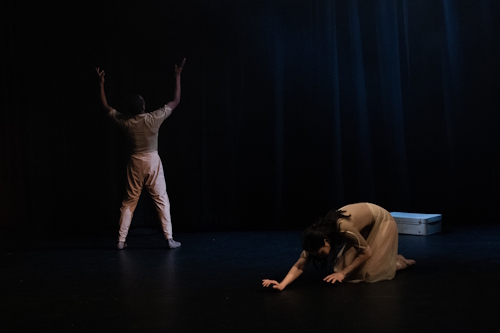
in Lot’s Wife by Marika Brussel
Photo Lynn Pryor
Brussel’s Slant of the Earth goes further back, looking afresh at the Genesis story of Abraham, Sarah and Hagar, with a twist on the ending, which is left open to audience interpretation.
The story is joined as Abraham (the strong but soft Ryan Upton), afraid for his life, tells Pharaoh that Sarah (Tamara Hinson) is his half-sister, not his wife. Both were in fact the case. Abraham, Sarah and her friend and maid Hagar (Michaela Marrable) then leave to begin again in a new country, a nation that God tells Abraham he and Sarah will parent. Brussel explains that she looked at the story as a sort of love quadrangle where, “Abraham loves God the most, Sarah loves Abraham the most, and Hagar loves Sarah the most.” After miscarriaging several times, Sarah convinces Hagar to be her surrogate, further complicating matters.
While the story is told with economy, the relationships are there for all to see. Again, it’s not difficult to translate events to modern-day figures. The choreography is polite but pleasing. Again, the cast danced beautifully and expressively, with the partnering particularly impressive.
The leading trio were ably supported by a backing chorus of Fadayiro, Suzuki, Greg Tyndall and Ellie Young. The small stage did make things look a little cramped when all seven dancers were present, but the space was used well.
The music, Hymns of Heaven and Earth by Canadian composer Peter-Anthony Togni; and The Despot’s Rage, the Slave’s Revenge, for ‘cello, piano and marimba, by San Francisco ballet and chamber music composer Shinji Eshima felt made for the ballet, fitting the action like a glove.
From Ash to Promise was a fine evening. The big guns may grab the headlines, but there is definitely a place and a need for small ensembles such as BalletMAR in the dance world. And how good it is to see a young ballet company working not only within the classical canon and with pointework but also with story. But that, and embracing London’s freelance artists, is what BalletMAR is all about, Brussel tells me. “We are committed to creating narrative ballets of depth and excellence that respond to the urgencies and possibilities of our times,” she says.
As BalletMAR seeks to extend its activities outside London, From Ash to Promise can next be seen at South East Dance’s The Dance Space in Brighton on February 27, 2026.